
 EN
EN
 UK
UK
 RU
RU
 AR
AR
 BN
BN
 ZH
ZH
 DE
DE
 ES
ES
 FR
FR
 HI
HI
 ID
ID
 UR
UR
 PT
PT
 TR
TR
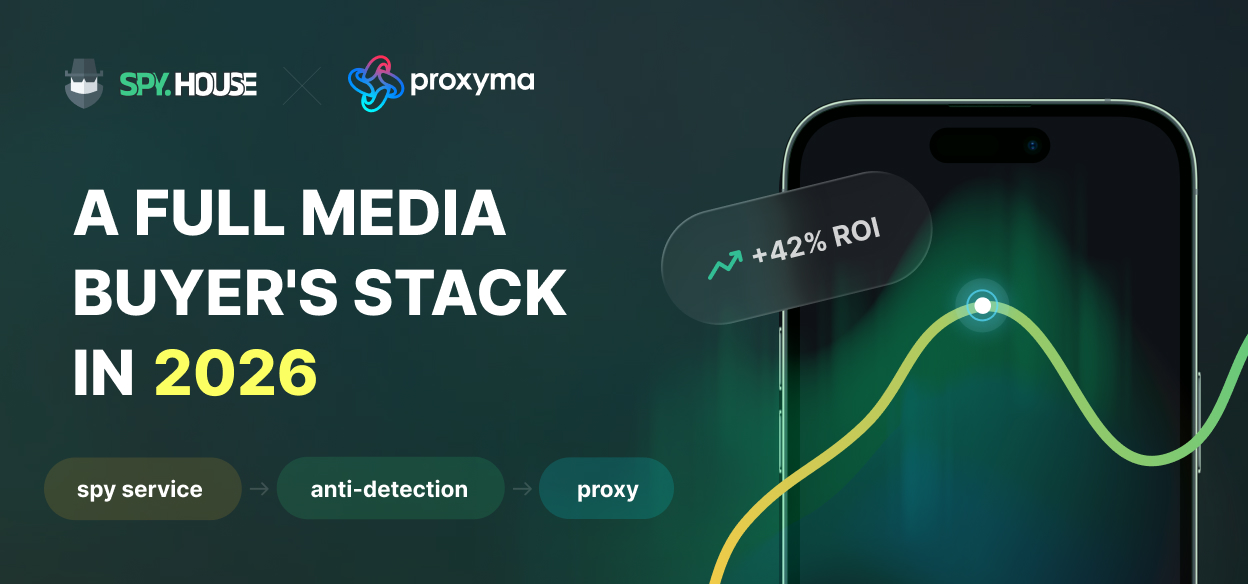
In affiliate marketing, people often talk about "bundles"—offers, sources, and creatives. But there is another bundle, often assembled blindly on the fly, that actually determines how many accounts survive until the end of the month. This is the technical stack: spy service, anti-detect browser, and proxies.
Each of these tools is well-studied individually. However, when they work together, it is vital to understand exactly how they interact, which element is responsible for what, and where weak points most often arise. That is exactly what we will break down in this article.
Three Tools – Three Different Tasks
Before discussing how to harmonize the stack, we must clearly define the areas of responsibility for each component.
Spy Service – Reconnaissance. It shows what is working for competitors right now: which creatives have been running for over two weeks (meaning they convert), which pre-landers are used in a specific GEO, and which offers are actively scaling. The spy service answers the question: "What to launch?"
Anti-detect Browser – Isolation. It creates independent browser profiles, each appearing to the platform as a separate device with a unique set of parameters: Canvas, WebGL, User-Agent, screen resolution, time zone, and fonts. The anti-detect browser answers the question: "How to avoid linking accounts together?"
Proxy – The Network Layer. It determines which IP address and which point in the world the platform sees the connection coming from. The proxy answers the question: "Where is this user coming from?"
It is important to understand: the anti-detect browser and the proxy solve different problems. The anti-detect hides the device. The proxy hides the network. The platform analyzes both layers simultaneously—and any discrepancy between them immediately becomes an alarm signal.
How a Spy Service Affects Proxy Choice
This point is often overlooked, but it is critically important for those working with cloaking.
Many profitable offers are protected by a cloaker—a system that shows different content depending on the parameters of the incoming request. Moderators and bots see a "white" landing page, while real users from the target GEO see the offer page.
When you research competitors via a spy service, the tool bypasses the cloaking and shows the real funnels. It does this, in part, using proxies with a high Trust Score in the target region. If you use low-quality proxies, you will see "stubs" or placeholders rather than the competitors' real landing pages.
There is a second aspect: when you find a working bundle and want to check how the landing page looks for a user in a specific city—for example, Warsaw or Miami—you again need a proxy with precise city-level targeting. Otherwise, you risk seeing something different from what your audience sees: a different price, language, or even a different offer.
Practical Conclusion: Proxies are necessary not only for launching campaigns but also for full-scale work with analytical tools. This doubles the requirements for their quality.
Why Anti-detect Doesn't Work Without a Good Proxy
Modern anti-fraud systems in Facebook, TikTok, and Google analyze a combination and consistency of parameters rather than individual ones.
Imagine a profile: Windows 11, New York, Chrome 124, 1920×1080 resolution, EST time zone. Everything looks convincing—the anti-detect has done its job. But the IP address geolocates to a data center in Frankfurt. The platform sees the discrepancy instantly.
Or another scenario: the proxy is residential, but the same IP is used for five accounts simultaneously. For the anti-fraud system, this is a pattern—not five different users, but one person with five profiles.
Three Errors That Kill Accounts Even With a Good Anti-detect:
Data Center IPs for Ad Cabinets. Server provider ranges have long been blacklisted. Regardless of how "clean" the browser fingerprint looks, a data center IP increases the risk of blocking exponentially.
One IP for Multiple Accounts. Platforms track which accounts log in from the same address. If several profiles log in from one IP within a short period, the anti-fraud system flags the connection and marks them as affiliated. The rule is simple: one account – one IP.
Mismatched IP Geography and Browser Settings. If the profile is set to the US but the IP geolocates to Southeast Asia, this isn't a real user. It’s a ban.
How to Build a Stack That Works
Let’s look at the specific mechanics for three main scenarios.
Scenario 1: Account Farming and Warm-up
At this stage, stability and IP cleanliness are paramount. The account must "live" on one address throughout the entire warm-up—changing the IP mid-session is as much a red flag as sharing it.
What you need: Residential proxies with sticky session support; one IP per profile; IP geolocation matching the anti-detect profile settings.
Scenario 2: Scaling – Launching Dozens of Cabinets Simultaneously
Here, proxy generation speed and pool size are critical. If you are firing up 50 accounts, you need 50 unique addresses that do not overlap and haven't been used by other advertisers.
What you need: A large pool with minimal sharing; fast generation via API or ports; support for country and city targeting.
Scenario 3: Gray Verticals – Nutra, Crypto
Platforms apply the most aggressive anti-fraud algorithms here. The IP must look as organic as possible—like a real user, not an advertiser.
What you need: Residential proxies with IPs belonging to real people; rotation configured "on request" (no automatic changes mid-session); HTTP/S and SOCKS5 support.
How to Verify Your Stack is Assembled Correctly
Before launching campaigns, ensure all three layers are consistent. One unaddressed parameter can cause days of account warm-up work to burn in seconds.
Minimum Checklist:
IP geolocation matches the time zone, language, and locale in the anti-detect profile.
WebRTC is not leaking (real IP is not visible through the browser).
IP is not on any public blacklists.
One profile = one proxy, sticky session for the entire duration of work.
IP belongs to an ISP or mobile operator, not a data center.
What to Look for When Choosing a Proxy Provider
The quality of the proxy determines the survivability of the entire stack. When choosing a provider for multi-accounting, consider:
Pool Size and Online Status: The larger the active pool, the less likely you are to get an address used by someone else.
Targeting: Country-level is the bare minimum. Most tasks require city-level targeting.
Session Type: Rotating and sticky modes should both be supported.
Protocols: HTTP/S and SOCKS5 are standard for compatibility.
IP Origin: Proxies should belong to real users, not server farms.
Support: 24/7 support with fast response times is a necessity.
One provider that meets these requirements is Proxyma. Their pool features over 60 million unique IP addresses with an average of 9 million active addresses online. Every IP belongs to a real user. They offer 190 countries with city targeting, HTTP/S and SOCKS5 protocols, and sticky sessions adjustable up to the minute. Integration is via API, payment is available in cryptocurrency, and 24/7 support typically responds within a minute. You can start with 500 MB for free—no card required.
Conclusion
A spy service, anti-detect browser, and proxies are not three separate tools to be configured independently. They are a system where each element affects the performance of the others.
The rule for a working stack is simple: an isolated browser environment plus a clean residential IP with matching geolocation. This makes every account look like a real user—because, technically, it is. Choosing a proxy provider isn't the last item on a "to-do" list; it’s a decision that must be made before the first launch. Once accounts are warmed up on a specific IP, switching providers becomes significantly more difficult.



Comments 0