
 EN
EN
 UK
UK
 RU
RU
 AR
AR
 BN
BN
 ZH
ZH
 DE
DE
 ES
ES
 FR
FR
 HI
HI
 ID
ID
 UR
UR
 PT
PT
 TR
TR
The world of traffic arbitrage in 2026 has finally split into "artisans" and "technologists." While the early 2020s allowed entry into the niche with a few hundred dollars and a bit of luck, today’s betting vertical has evolved into a complex ecosystem where the cost of a mistake is measured in thousands of dollars. The main myth to debunk immediately is the existence of a "money button." Old approaches, such as direct linking to a bookmaker's landing page with aggressive slogans like "Become a millionaire overnight," no longer work. Advertising algorithms on Meta, Google, and TikTok have learned to recognize such manipulations instantly.
The current state of the niche is characterized by global legalization. The US, Latin America, and several Southeast Asian countries have opened their markets, bringing massive capital into arbitrage. Competition has intensified, but so has the volume. Sports broadcasting schedules have expanded, and esports (Dota 2, CS 3, Mobile Legends) has firmly established itself at the top, sometimes exceeding classic football in betting volume. Arbitrage is alive, but it has become a high-tech business where winners are those whose betting creatives strike the psychological chord of a specific GEO.
The Economics of Arbitrage: Numbers, Budgets, and Model Selection
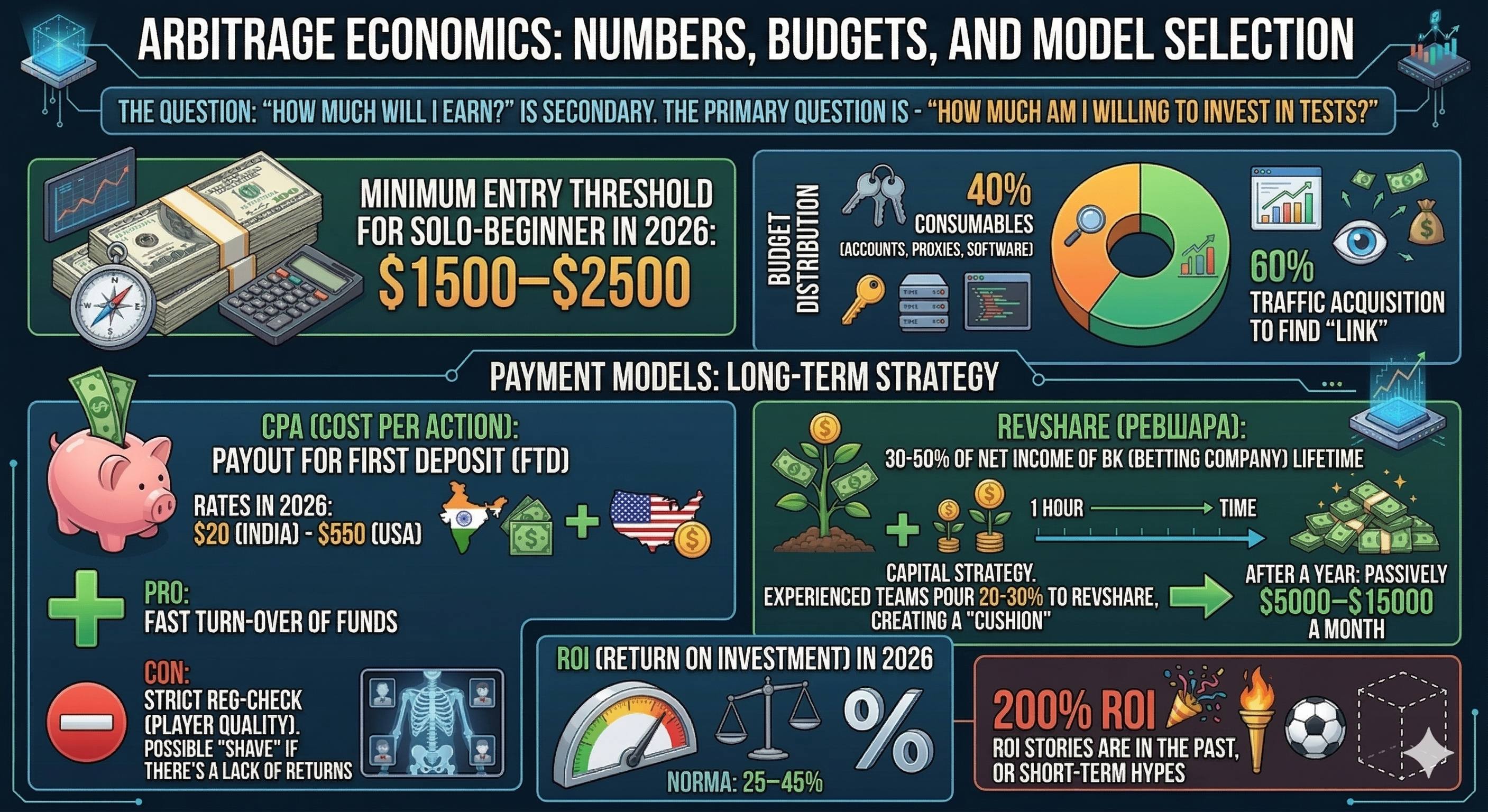
The question "How much will I earn?" is secondary. The primary question is "How much am I ready to invest in tests?". In 2026, the minimum entry threshold for a solo beginner is $1,500-$2,500. This budget is distributed as follows: 40% on consumables (accounts, proxies, software) and 60% on traffic acquisition to find a "winning funnel."
Payment Models: Long-Distance Strategy
CPA (Cost Per Action): Payment for the first deposit (FTD). This is the baseline for beginners. Rates in 2026 range from $20 (India) to $550 (USA). The pro is fast capital turnover; the con is a strict "reg-check" (player quality audit). If your players don't return to the app, payouts may be "shaved."
RevShare: You receive 30-50% of the bookmaker's net profit from a player's losses for life. This is a strategy for building capital. Experienced teams allocate 20-30% of traffic to RevShare, creating a "cushion" that can generate $5,000-$15,000 in monthly passive income after a year.
ROI (Return on Investment): In 2026, an ROI of 25-45% is considered the norm. Stories of 200% ROI are a thing of the past or apply only to short-term hype events like the Champions League Final or the Olympic Games.
Geography of Profit: Where to Run Traffic in 2026?
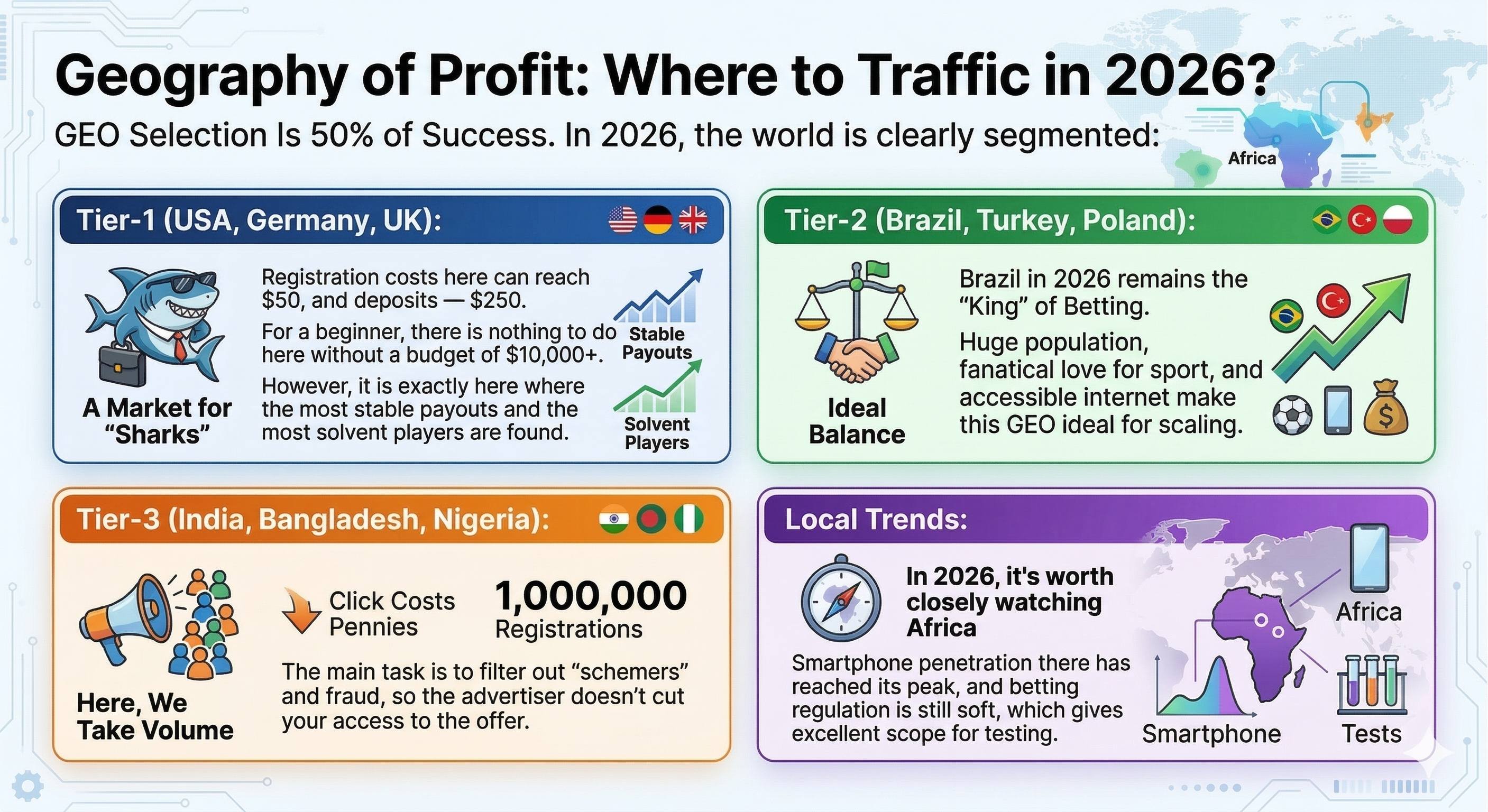
Choosing a GEO is 50% of your success. In 2026, the world is clearly segmented:
Tier-1 (USA, Germany, UK): The market for "sharks." Registration costs can reach $50, and deposits $250. Beginners have no business here without a budget of $10,000+. However, this is where you find the most stable payouts and high-LTV players.
Tier-2 (Brazil, Turkey, Poland): The ideal balance. Brazil remains the "king" of betting in 2026. A massive population, fanatical love for sports, and accessible internet make this GEO perfect for scaling.
Tier-3 (India, Bangladesh, Nigeria): Here, we focus on volume. Clicks cost pennies, and registrations come in the thousands. The main task is filtering out "scheme-seekers" and fraud so the advertiser doesn't cut off your access to the offer.
Local Trends: In 2026, keep a close eye on Africa. Smartphone penetration has peaked, and betting regulations are still soft, providing excellent room for testing.
Traffic Sources: Where Does Your Target Audience Live?
Facebook & Instagram
The "evergreen" source. In 2026, work here is built on high-end anti-detect browsers and setups involving "Kings" (high-trust accounts) and auto-registered accounts. The main challenge is moderation. To pass, your betting creatives must be as native as possible. Videos showing genuine human emotions perform 3x better than rendered graphics in 2026.
TikTok & Shorts
The era of UBT (unconditionally free traffic). Newcomers use smartphone farms for mass video uploads. The secret to success is using AI to generate unique footage every 15 minutes. If a video hits recommendations in a "football-crazy" country, you can get 100+ deposits in an evening without spending a cent on ads.
Telegram and In-app
Telegram has become the primary funnel for "scheme" traffic and capper channels. In 2026, users trust "expert advice" more than banners. In-app (advertising inside mobile applications) remains the most expensive and highest-quality source, accessible primarily to large teams.
Technical Kitchen: The 2026 Tool Stack
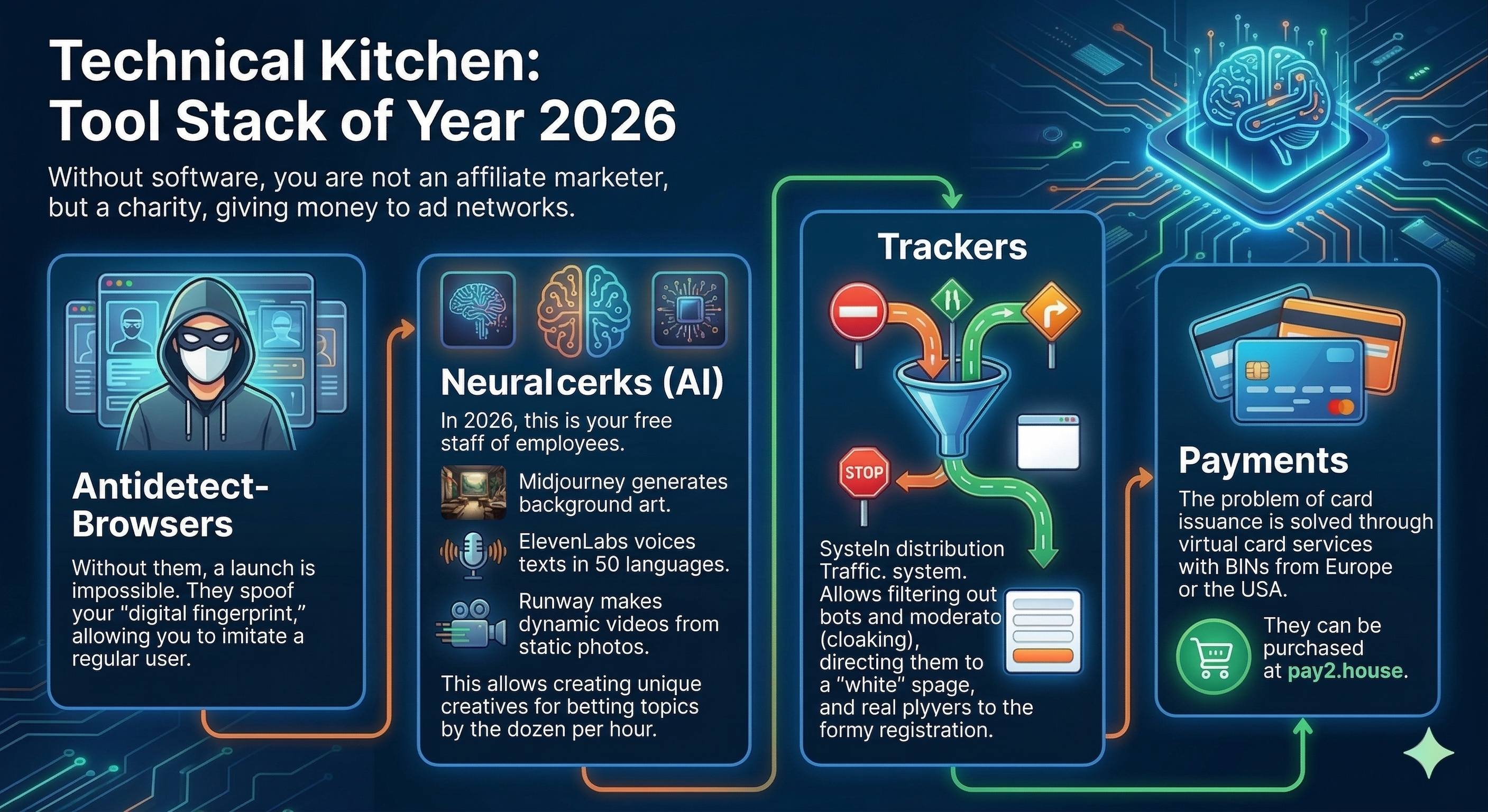
Without software, you aren't an arbitrageur; you're a philanthropist donating to ad networks.
Anti-detect Browsers: Essential for launching. They spoof your "digital fingerprint," allowing you to mimic an ordinary user.
Artificial Intelligence (AI): In 2026, this is your free staff. Midjourney generates backgrounds, ElevenLabs voices scripts in 50 languages, and Runway turns static photos into dynamic videos. This allows for the production of dozens of unique betting creatives per hour.
Trackers: The traffic distribution system. It allows you to filter out bots and moderators (cloaking), directing them to a "white" page while real players go to the registration form.
Payments: The issue of issuing cards is solved through virtual card services with EU or US BINs. They can be purchased on the pay2.house service.
Step-by-Step Launch Algorithm: From Idea to First Deposit
Network Registration: Choose a network with a history. Ask the manager for "stats" on a specific GEO.
Funnel Preparation: In 2026, the "Ad -> App (PWA) -> Registration" flow works best. PWA apps mimic store interfaces and inspire more trust.
Content Production: Prepare 10-20 videos. Remember: betting creatives have a short lifespan-from a few days to a week. As soon as the cost-per-click creeps up, change the visual.
Launch and Optimization: Start with small budgets ($20-50 per day per adset). Look for the "hook"-when the social network algorithm finds the right audience and the first registrations roll in.
Scaling: If ROI is above 30%, increase the budget by 15-20% every 24 hours. Avoid sudden moves, or the account will be flagged for review.
Psychology and Triggers: Why Do They Bet?
Arbitrage is applied psychology. In 2026, three main triggers drive betting:
Escapism: An opportunity to escape gray daily routines and get an adrenaline rush.
Social Proof: "My neighbor won and bought a car; I can too." This is why UGC (User Generated Content) videos are currently at the top.
Patriotism: Betting on the national team or a local hero (e.g., Makhachev’s fights or Vinícius’s matches).
Your betting campaigns should exploit these feelings subtly. Direct "Go and bet" calls to action work worse than a success story or a "smart betting" strategy breakdown.
Conclusion: Is It Worth Entering the Niche?
Betting arbitrage in 2026 is not a lottery; it is a mathematical model. Yes, the entry barrier has risen, and technical complexities may be daunting. But no other vertical offers such stability over the long term. People will always bet—in times of crisis and times of prosperity.
Main advice for the beginner: Do not try to cover everything. Choose one GEO (e.g., Brazil), one source (e.g., Facebook), and hit one spot until you get a result. In 2026, the winner is not the smartest, but the most disciplined analyst. Remember, high-quality betting creatives are your key to the player's heart and the advertiser's wallet.



Comments 0