
 EN
EN
 UK
UK
 RU
RU
 AR
AR
 BN
BN
 ZH
ZH
 DE
DE
 ES
ES
 FR
FR
 HI
HI
 ID
ID
 UR
UR
 PT
PT
 TR
TR
How to Validate Local Funnels Before Scaling International Campaigns
Finding a profitable campaign in a new GEO is not usually the difficult part anymore.
For most experienced media buyers, the harder part begins after that.
You identify a promising funnel inside Spy.house.
The creatives look active.
The engagement looks healthy.
The angle appears proven.
From the outside, everything seems ready.
Then traffic goes live — and the real performance does not match what the research suggested.
That is often the point where buyers realize something important:
the funnel they reviewed was not always the same funnel real users were seeing.
And in international campaigns, that small difference can quietly affect an entire scaling decision.
Why the Same Funnel Can Behave Differently
Many advertisers no longer serve the exact same experience to every visitor.
Instead, funnels can adapt based on signals such as:
visitor country
mobile carrier
browser language
device type
connection source
previous session data
That means two people opening the same page can still land inside two completely different experiences.
Sometimes the difference is minor.
Sometimes it changes:
the landing page
the checkout flow
the pricing logic
the upsell sequence
the final conversion path
When that happens, a campaign can look profitable during research while behaving differently once real traffic arrives.
Why Standard Validation Can Be Misleading
A lot of buyers still validate funnels from a normal desktop connection.
That is understandable.
The page loads.
The offer is visible.
The checkout works.
But modern platforms often evaluate much more than that.
They may look at:
the ASN behind the IP
DNS consistency
mobile network trust
browser fingerprint
session authenticity
Those signals can influence what version of the funnel gets delivered.
So the page you see during research may only be a simplified version of what the platform serves to actual users.
That is where inaccurate validation usually begins.
Carrier-Level Targeting Is More Common Than Most Buyers Think
One thing more advanced teams eventually notice is that some funnels do not only segment by location.
They also segment by carrier.
A user connected through:
Verizon
Claro
Vivo
Movistar
Orange
may see a different experience than someone visiting through a datacenter IP.
That can affect:
local payment methods
subscription flows
redirect behavior
country-specific pricing
mobile-only pages
From a distance, the campaign looks identical.
Inside the session, it may not be.
That is why validating only the URL is often not enough.
Why DNS Quietly Changes Validation
Many people focus only on the IP address.
More experienced buyers eventually start paying attention to DNS.
Because some platforms compare:
IP country
carrier ASN
DNS resolver
route consistency
device signals
If those elements do not align naturally, the session may look synthetic.
And once that happens, the platform can return:
a generic page
a backup funnel
a safer redirect
a simplified checkout
The page still loads.
But what you are reviewing may no longer be the real funnel.
That can create false assumptions before scale.
Some buyers reduce that mismatch by validating through NafeProxys, where native carrier DNS helps preserve a browsing profile that looks closer to genuine mobile traffic.
Where Mobile Proxies Become Useful
This is where mobile proxies stop being just another technical tool.
They become part of a cleaner validation process.
A properly configured mobile proxy can recreate:
a real mobile IP
a legitimate carrier ASN
native carrier DNS
a natural browsing route
a more authentic session profile
That creates an environment that looks closer to a normal user instead of an inspection session.
And that distinction matters more in international campaigns than many buyers first assume.
For teams that rely on accurate validation, using a dedicated mobile environment through NafeProxys mobile proxies can help remove part of that uncertainty.
A Practical Example
Imagine a buyer reviewing a campaign targeting Spain.
Inside Spy.house the campaign looks promising:
stable ad volume
consistent creatives
long-running placements
A standard desktop check shows a clean funnel.
Nothing appears unusual.
But the same page opened through a Spanish mobile carrier may reveal:
different copy
another domain
localized checkout
alternate payment options
a mobile-specific upsell
Without seeing that version, the campaign can be misunderstood.
And in some cases, that misunderstanding becomes expensive.
What Experienced Buyers Usually Validate
Over time, experienced buyers stop validating only the page.
They start validating the session itself.
That usually means checking:
the country
the network
the carrier
the DNS
the browser
the device consistency
Because sometimes the environment behind the click reveals more than the ad itself ever could.
When This Matters Most
This becomes especially important in verticals where localization affects conversion.
Subscription Offers
Carrier billing can behave differently depending on the network.
Finance Funnels
Compliance often changes by country.
Nutra Campaigns
Some GEOs receive entirely different funnels.
Multi-GEO Campaigns
Different markets can follow completely different monetization paths.
The more advanced the operation becomes, the more infrastructure starts to matter.
Mobile Infrastructure as Part of the Workflow

For teams running campaign validation across multiple markets, the connection itself eventually becomes part of the workflow.
At a certain level, the goal is no longer just opening a page.
The goal is seeing the same environment the platform expects from a real user.
That usually means matching:
mobile carrier trust
native DNS routing
geographic consistency
device-level signals
clean session behavior
That is where infrastructure starts to matter.
NafeProxys was built specifically for buyers who need a more reliable way to validate funnels across different GEOs without relying on unstable residential pools or generic datacenter IPs.
The network is built around:
dedicated Android devices
real 4G and 5G carrier IPs
native carrier DNS
legitimate telecom ASN
manual or automatic IP rotation
unlimited bandwidth
HTTP, SOCKS5 and OpenVPN support
Available countries currently include:
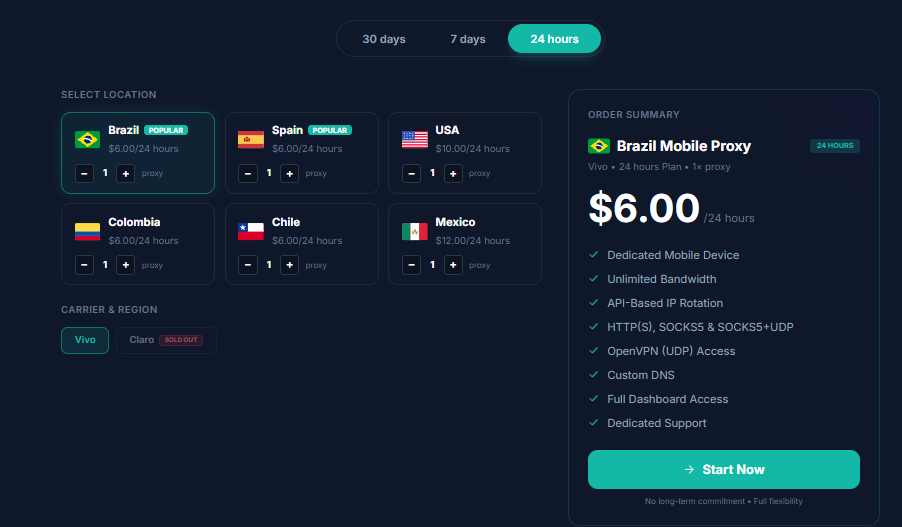
USA
Mexico
Colombia
Chile
Brazil
Spain
Because every session runs through a physical mobile device connected to a real carrier network, the browsing environment feels significantly closer to what many ad platforms treat as legitimate user traffic.
For buyers working with sensitive funnels, that can make the difference between reviewing a generic fallback page and seeing the actual conversion path.
Buyers who need a cleaner environment for international validation can explore the full NafeProxys network to build a more reliable testing workflow.
Final Thought
Finding campaigns has become easier.
Understanding what users actually experience is still where many buyers gain an edge.
Spy.house helps uncover what is already working.
The right connection helps confirm whether that opportunity is real.
And for buyers working across multiple markets, that difference can influence every decision that follows.
If international validation is already part of your workflow, you can learn more about building a cleaner testing environment through .





Comments 0