
 EN
EN
 UK
UK
 RU
RU
 AR
AR
 BN
BN
 ZH
ZH
 DE
DE
 ES
ES
 FR
FR
 HI
HI
 ID
ID
 UR
UR
 PT
PT
 TR
TR
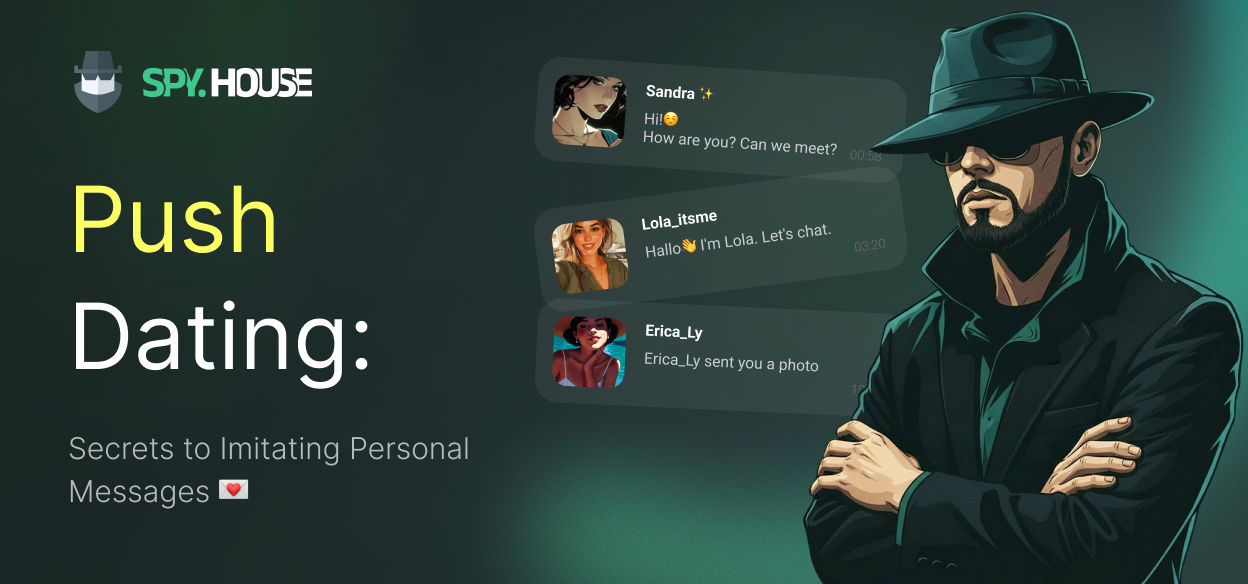
Why is Classical Dating Marketing Dying?
Traditional methods of grabbing attention no longer bear fruit. If five years ago a bright banner saying "Register and Find Love" ensured a steady stream of leads, today the situation has changed dramatically.
1. The Perception Crisis: The Zenith of "Banner Blindness"
We are facing a global phenomenon where the user's brain subconsciously filters out any content showing signs of commercial intent.
What blocks the brain: Professional retouching, stock smiles, and straightforward calls to action (CTAs).
The Result: Advertising is instantly identified as information noise.
2. Push Notifications: The Last Frontier
Push notifications in dating remain one of the few channels capable of breaking through this protective barrier. However, there is a critical condition: they must not look like ads.
The problem with classical dating marketing: Straightforwardness. Phrases like "The best dating site in your city" betray the presence of a corporation and an algorithm, triggering automatic rejection.
3. The Psychology of the Click: Personal vs. Advertising
The difference between an "advertising push" and a "personal notification" is the chasm separating a wasted budget from a high ROI.
Mechanics: A personal notification mimics social interaction. It appeals to the basic need for communication and recognition.
The Trigger: When a message formatted like a messenger notification pops up on a smartphone screen, a dopamine loop is triggered: "Someone wrote to me personally."
The Effect: At this moment, critical thinking switches off, giving way to pure curiosity.
4. The "Neighbor Girl" Concept
This is not just a marketing trick, but a deep psychological strategy of mimicry. The "neighbor" image is based on subconscious trust in familiar archetypes.
Instead of unreachable models: We offer the image of a girl you might meet in line for coffee, in an elevator, or in the neighboring yard.
Why it works: In a world overflowing with perfect filters and artificial intelligence, the imitation of sincerity becomes the most expensive currency.
Summary: The media buyer stops selling a "dating service"—they begin offering the "opportunity to communicate with a real person." In the following sections, we will break down how to turn this mechanism into specific technical creative settings.
II. The Psychology of the Click: Why Do We Believe "Neighbor Girls"?
In 2026, smartphone users are overwhelmed by impersonal notifications from banks and delivery services. In this digital noise, the brain seeks social anchors, and the success of modern dating strategies is built on this very attention deficit.
1. Recognition Trigger: Social Signal vs. Advertising
Evolutionarily, our brains are wired to pick out faces and social symbols from the general flow of information.
Interface Mimicry: When a push notification copies the style of WhatsApp or Telegram, the user reacts not to an "offer," but to a social signal.
Dopamine Loop: The sound of a notification and an icon with a real person's face trigger a micro-release of dopamine.
Result: The social obligation (to answer a message) proves stronger than the rational reluctance to view an ad.
2. Accessibility vs. Elitism
Traditional "gloss" creates a distance that the brain instantly reads as fake.
Top Models: Perfect retouching and evening gowns signal: "This isn't for you; this is an ad or a bot."
The "Neighbor" Effect: An ordinary selfie in a bathroom mirror or a car interior broadcasts reality. Imperfect lighting and a lack of makeup are signs that the person exists in the user's physical space.
3. The Zeigarnik Effect (Unfinished Gestalt)
The psyche always strives for closure. When push text cuts off mid-sentence or asks an open-ended question, cognitive tension arises.
Hook examples: * "Listen, wasn't that you I saw yesterday in..."
"I was thinking about your offer..."
Mechanics: The user begins to complete the story in their head, even if they realize it’s unlikely. Curiosity overrides critical thinking.
4. The Illusion of Personal Appeal
In the dating vertical, you don't sell site functionality; you sell the illusion of possibility.
Role Reversal: We shift communication from "Brand–Consumer" to "Person–Person."
The "Chosen One" Effect: The creative makes the user forget that thousands of others received the same message. They feel like the sole recipient, which is the shortest path to the target action.
III. Anatomy of the Ideal "Neighbor" Push
For the "neighbor" concept to transform from an abstract idea into a high CTR and real profit, the push notification must be dissected into its components. In traffic arbitrage, no detail is too small.
The Icon (Small Image): Your Main Weapon
The icon is the first thing the eye sees on a locked screen. It acts as a messenger avatar. Avoid "advertising polish."
Best choice: A close-up of a girl's face, taken with a front-facing camera. Direct eye contact creates a psychological effect.
Background: Slightly blurred or containing domestic details (home, store shelves, car interior). Natural imperfections—a stray lock of hair or lack of studio makeup—confirm the character's reality.
The Title: Mimicking an Incoming Dialogue
The title is the "hook." Use dynamic insertion macros for maximum effectiveness (e.g., {city}, {device}, or {day_of_week}).
Example: "Lena from {city} sent you a photo." Seeing their own city name increases the trust level significantly.
System Mimicry: Titles like "(1) New Message" or "Missed call from Katya" trigger the automatic communication reflex.
The Main Text (Description): The Art of Understatement
The text should look like a fragment of real speech taken out of context.
Instead of: "Join our site and start dating."
Use: "Listen, do you happen to live in that neighborhood? I saw a guy who looked just like you..." or "I'm all alone today and decided to write to you. Want to see what I bought?".
The Intrigue: Hiding the end of the sentence behind the push visibility limit forces the user to click to "read more" or "see the photo."
The Big Image: Is "Heavy Artillery" Necessary?
Pros: Takes up more screen space and allows showing the "neighbor" in full height.
Cons: Native WhatsApp/Telegram notifications don't usually show large previews.
The Rule: If used, the Big Image must continue the "legend." It should look like a photo "she" just sent to the chat (a mirror selfie, a photo of her feet at the beach, or a home photo with a cat).
IV. Visual Strategies and Approaches (Angles)
In 2026, the winner is not the one with the prettiest photo, but the one who matches the user's current mood.
"Bored Housewife": Best for evening traffic. Focuses on home comfort (oversized hoodies, tea, soft lighting). Appeals to the need to escape loneliness.
"Active City Girl": Ideal for daytime. Selfies in elevators, business centers, or cars. Uses location macros: "Are you downtown right now? I think I just saw you at the mall..."
"Night Chat": High-conversion, high-competition. Slightly bolder visuals (dim lighting, pajamas) and short, punchy titles: "You awake?" or "I'm bored under the covers alone..."
"Wrong Recipient": A provocative angle. "Oops, sorry, that wasn't for you... Wait, you're actually cute! What's your name?" This bypasses defensive barriers instantly.
"Asking for Help": People love to be experts. A photo of a girl in a fitting room: "I can't choose, which one looks better on me? Help me out?"
V. GEO-Specificity: How the "Neighbor" Changes from Germany to Brazil
Tier-1 (USA, W. Europe, Canada): "No Filter" aesthetics. Minimal makeup, yoga-style clothing, intellectual sexiness (glasses, books).
Tier-2/3 (Latin America): Temperament and bright colors. Expressive, soul-of-the-party types, more emojis, and focus on the figure.
Tier-3 (Asia): Modesty and "Kawaii." Fair skin, cute cafes, aesthetic blogger style. The text should be soft and slightly shy.
CIS and Eastern Europe: Domestic realism. Photos in elevators, supermarkets, or against apartment blocks. Direct and relatable texts about local weather or neighborhoods.
VI. Technical Implementation and Testing: AI vs. Spy Services
The Problem with "Used" Creatives: Do not copy top creatives from Spy services "as is." Use them for ideas, then create unique content.
AI (Stable Diffusion, Midjourney): Use prompts to add "defects" (low quality, grainy, bad lighting) to avoid the "AI plastic" look. Ensure consistency by using the same face across the whole funnel.
A/B Testing: Systematically test the Icon (50% of success), the Title, and the Body length.
Optimization: Push creatives "burn out" in 2–7 days. Refresh them by mirroring images or changing background colors.
VII. The "Push – Preland – Offer" Funnel: Maintaining the Legend
The transition must be seamless. If the user clicks on "Lena," they must see "Lena" on the prelander.
The Prelander as a "Chat": Use scripts that mimic "Masha is typing..." to create a real-time effect.
Interactive Quizzes: Simple questions like "Are you over 18?" engage the user through micro-commitments.
Soft Closing: Don't sell a "subscription." Sell "access to this specific girl": "I'm rarely here, message me on my profile so I'll see it."
VIII. Ethics and Moderation: Clickbait without the Ban
Clickbait vs. Mislead: Intrigue is fine; outright lying (e.g., "You received $5000 from Elena") is not.
Moderation Hacks: Use "Safe Pages" (white prelanders) for initial checks and euphemisms (e.g., "Evening adventure" instead of "One night stand").
AI vs. AI: Use uniqueizers to bypass automated image analysis by changing metadata and adding invisible noise.
IX. Conclusion: The "Million-Dollar Neighbor" Checklist
Before launching, check:
Visual Authenticity: Does she look real for this GEO/weather?
Technical Execution: Is the face clear on a small icon? Are macros working?
Scenario Logic: Does the time of day match the text? Is there a "hook"?
Funnel Seamlessness: Is the image consistent from push to registration?
Pro Tip: Sometimes the "dirtiest" creative with bad lighting and a deliberate typo performs better than a polished agency campaign. Be simple, be human, and the user will reward you with that coveted click.




Comments 0