
 EN
EN
 UK
UK
 RU
RU
 AR
AR
 BN
BN
 ZH
ZH
 DE
DE
 ES
ES
 FR
FR
 HI
HI
 ID
ID
 UR
UR
 PT
PT
 TR
TR
Affiliate Marketing in 2026: From "Luck" to Mathematical Dominance
In 2026, affiliate marketing has finally transformed from a "market of luck" into an industry of mathematical superiority. While at the beginning of the decade a media buyer could rely on intuition, today success is 80% dependent on the quality of your software, the integrity of transmitted data, and the ability to manage neural network models.
Chapter 1. Market Landscape and the Technological Barrier
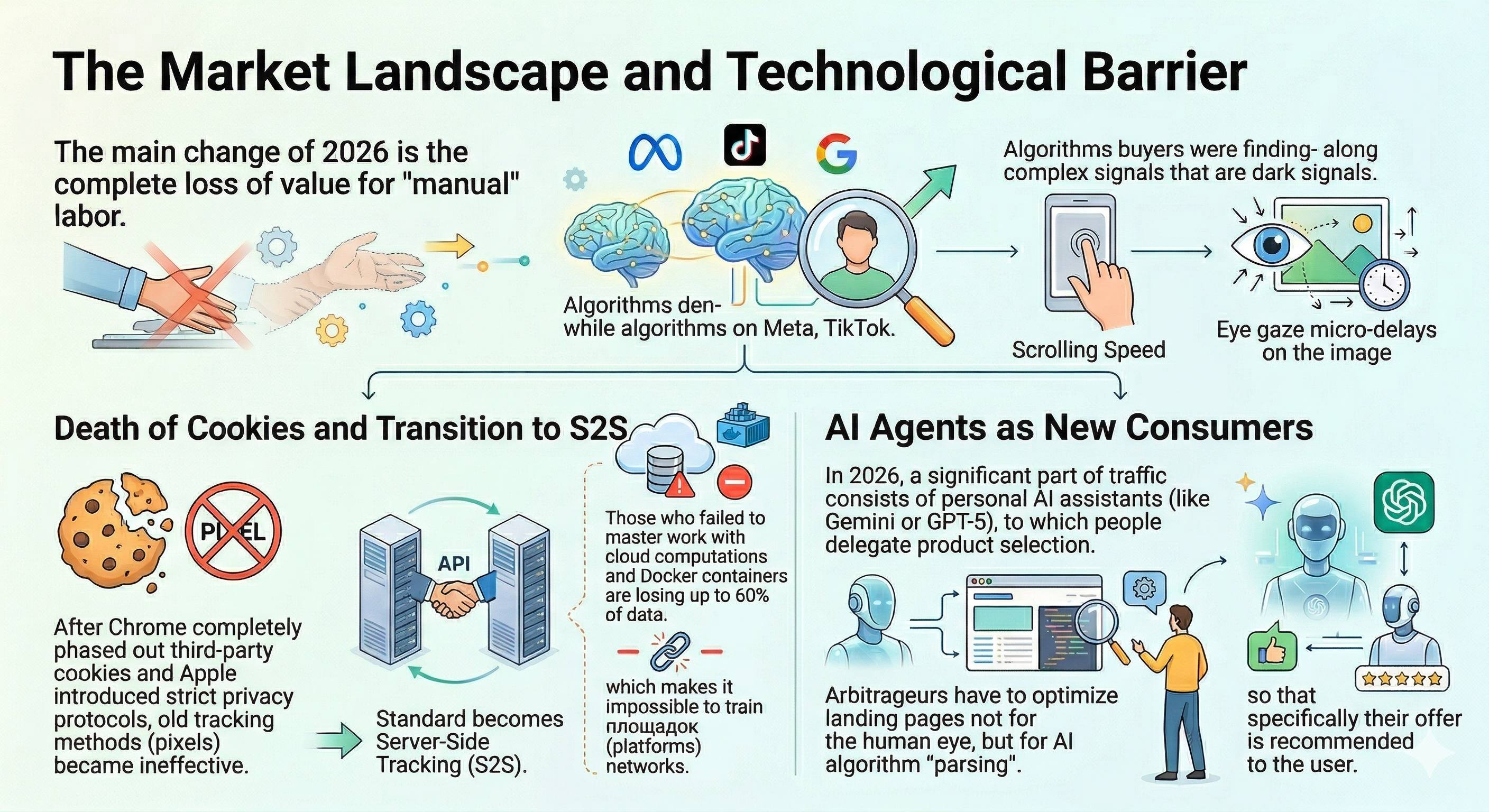
The main shift of 2026 is the complete loss of value in "manual" labor. Ad algorithms from Meta, TikTok, and Google have become so sophisticated that they find buyers better than any human, based on millions of hidden signals: from scrolling tempo to micro-delays in eye movement on an image.
1.1. The Death of Cookies and the Transition to S2S
Following Chrome's total phase-out of third-party cookies and Apple's implementation of strict privacy protocols, old tracking methods (pixels) have become ineffective. Server-Side Tracking (S2S) has become the standard. This means conversion data is transmitted directly from your server to the ad network's server via API. Those who haven't mastered cloud computing and Docker containers are losing up to 60% of their data, making it impossible to train the platforms' neural networks.
1.2. AI Agents as the New Consumers
In 2026, a significant portion of traffic consists of personal AI assistants (like Gemini or GPT-5) to which people delegate product selection. Affiliates now have to optimize landing pages not for the human eye, but for algorithmic "parsing" to ensure their offer is the one recommended to the user.
Chapter 2. Current Verticals: Where is the Money?
2.1. FinTech and RWA (Real World Assets)
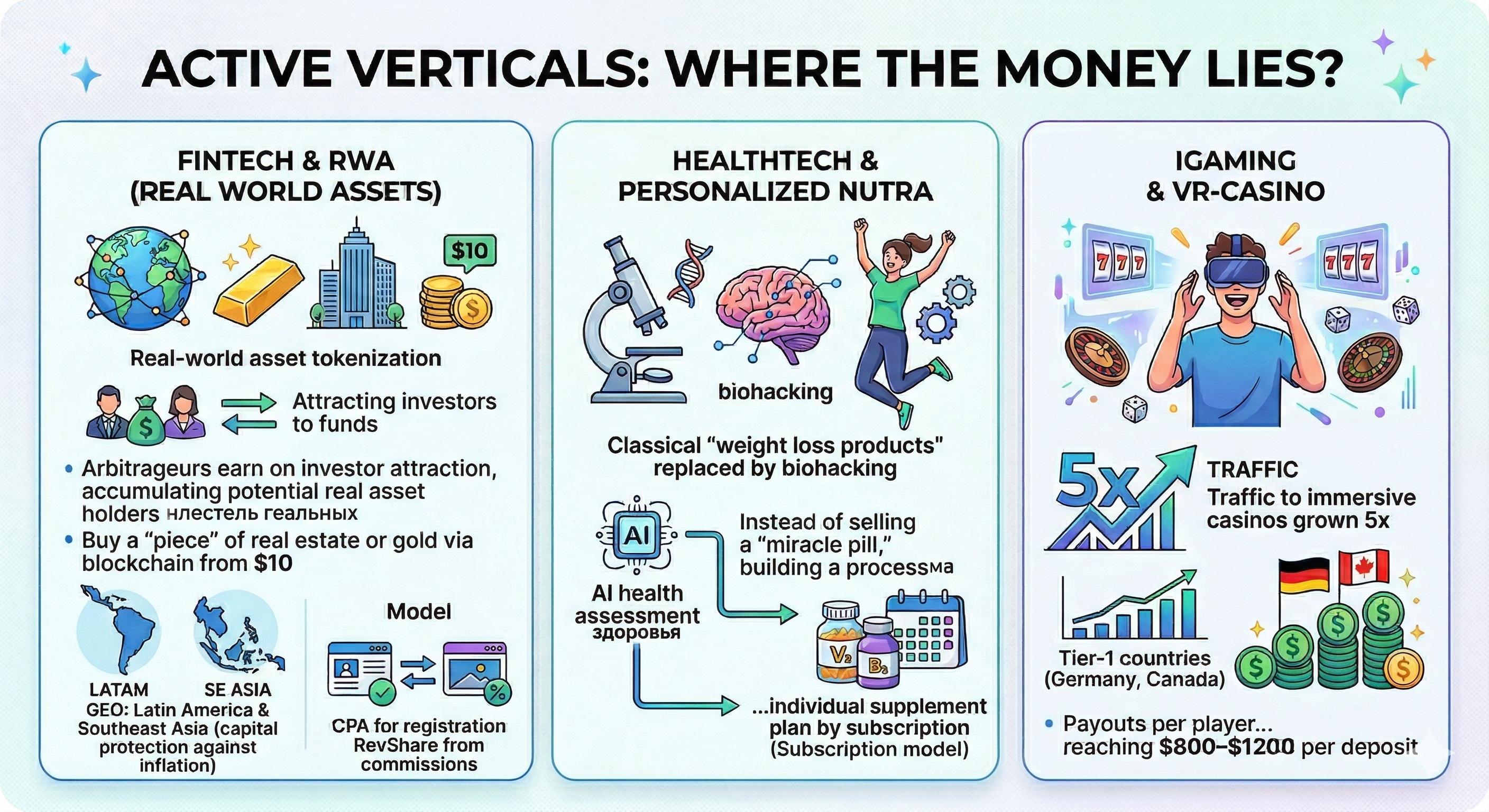
The tokenization of real-world assets is the leading trend. Affiliates earn by attracting investors to funds that allow purchasing a "piece" of real estate or gold via blockchain starting from $10.
GEOs: Latin America and Southeast Asia (capital protection against inflation).
Model: CPA for registration + RevShare from commissions.
2.2. HealthTech and Personalized Nutra
Classic "weight loss pills" have been replaced by biohacking. Instead of selling a "miracle pill," the funnel is built on a free AI health assessment, after which the client is offered a customized supplement plan via a Subscription model.
2.3. iGaming and VR Casinos
With the release of affordable augmented reality headsets, traffic to immersive casinos has grown fivefold. Payouts for a single player in Tier-1 countries (Germany, Canada) reach $800–$1,200 per deposit.
Chapter 3. Traffic Sources and Content
3.1. TikTok Shop and Live Streams
Sales happen within the app. Affiliate teams use AI avatars that host 24/7 streams, demonstrating products and answering viewer questions in 50 languages simultaneously with perfect lip-syncing.
3.2. OEM Traffic
Advertising within smartphone system skins (Xiaomi, Samsung). This is "clean" traffic that cannot be blocked by ad-blockers.
3.3. Telegram Mini Apps (TMA)
Telegram has become a full-fledged OS. Creating apps within the messenger allows closing deals through built-in acquiring and TON, bypassing external websites.
Chapter 4. Technical Setup of Ad Accounts
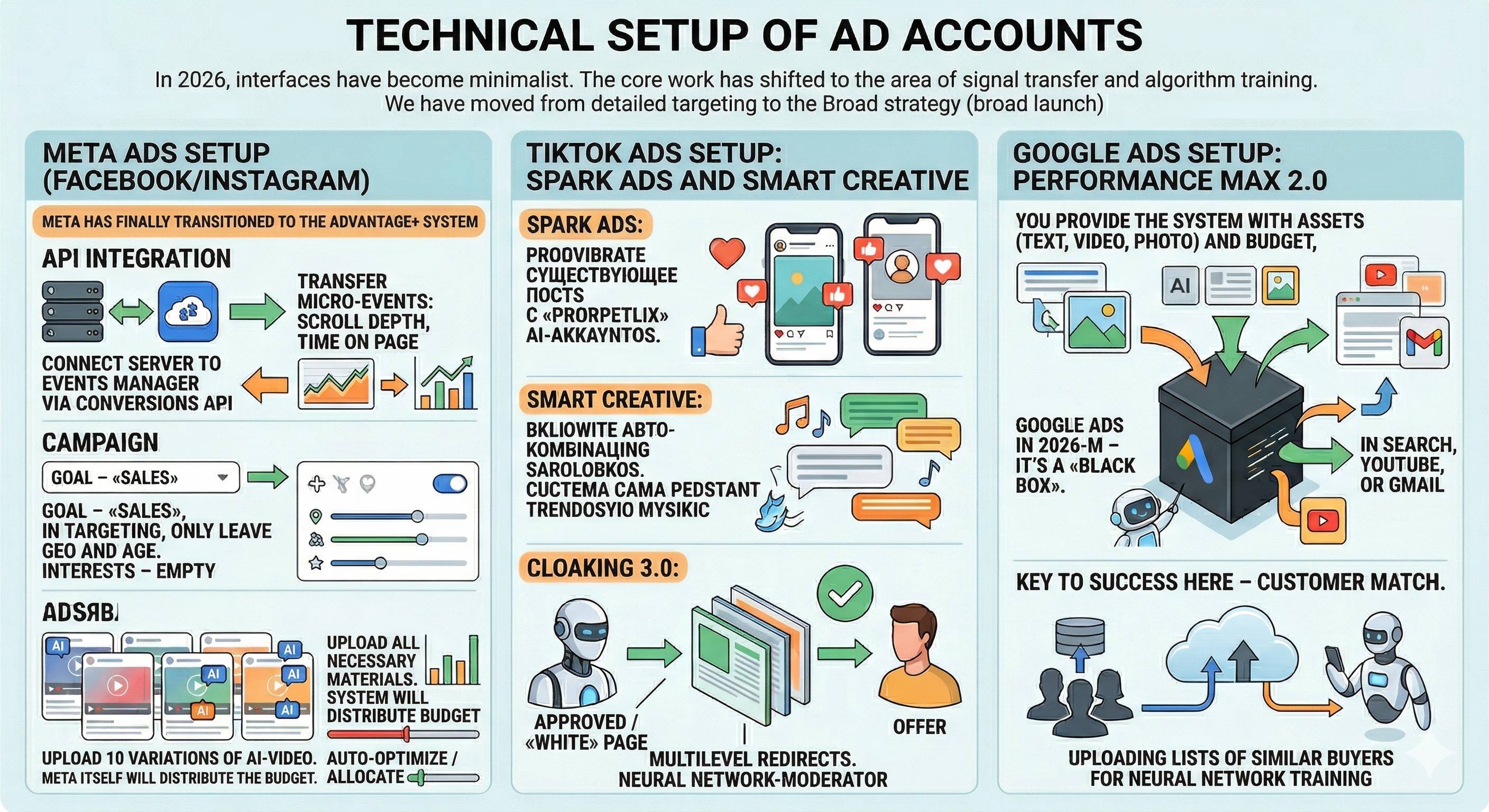
In 2026, interfaces have become minimalist. The bulk of the work has shifted to signal transmission and algorithm training. We have moved away from detailed targeting toward a Broad strategy.
4.1. Meta Ads Setup (Facebook/Instagram)
Meta has fully transitioned to the Advantage+ system.
Step 1: API Integration. Before clicking "Create," link your server to Events Manager via Conversions API. Pass not just the purchase, but "micro-events": scroll depth and time on page.
Step 2: Campaign. Objective — "Sales." In targeting, leave only GEO and age. Keep interests empty.
Step 3: Ads. Upload 10 variations of AI-generated video. Meta will automatically distribute the budget to the clip that best retains attention.
4.2. TikTok Ads Setup: Spark Ads and Smart Creative
Spark Ads: Promote existing posts from "warmed-up" AI accounts. This generates more trust than standard In-Feed ads.
Smart Creative: Enable auto-combination of headlines. The system will automatically overlay trending music for a specific region (e.g., Indonesian pop for users in Jakarta).
Cloaking 3.0: For "grey" niches, use multi-level redirects. The moderator neural network must see a "white" page, while a real human sees the offer after verification.
4.3. Google Ads Setup: Performance Max 2.0
Google Ads in 2026 is a "black box." You provide the system with assets (text, video, photos) and a budget, and it decides where to show the ad: in Search, YouTube, or Gmail. The key to success here is Customer Match (uploading lists of similar buyers to train the neural network).
Chapter 5. Data Management: Postback and Attribution
Affiliate marketing is impossible without an advanced tracker.
5.1. Postback Mechanism
This is a signal from the affiliate network to your tracker, and then back to the ad account. This is necessary so the ad network can "see" the buyer's profile and start looking for similar ones (Look-a-like in real-time). Without data feedback, the algorithm goes "blind."
5.2. Attribution Models
Forget about "Last Click." Use Data-Driven Attribution. If a user touched your ad across three networks, the system will distribute value among all touchpoints, allowing you to see the true Customer Acquisition Cost (CAC).
Chapter 6. Creative Strategy: Psycholinguistics and AI
In 2026, accounts utilize DCO (Dynamic Creative Optimization).
Hyper-localization: For a rural resident, AI will generate text about "affordability"; for a city dweller, about "innovation."
UGC 2.0: Perfect editing now causes rejection. "Honest" content is in style: shaky camera, raw emotions, and an absence of filters.
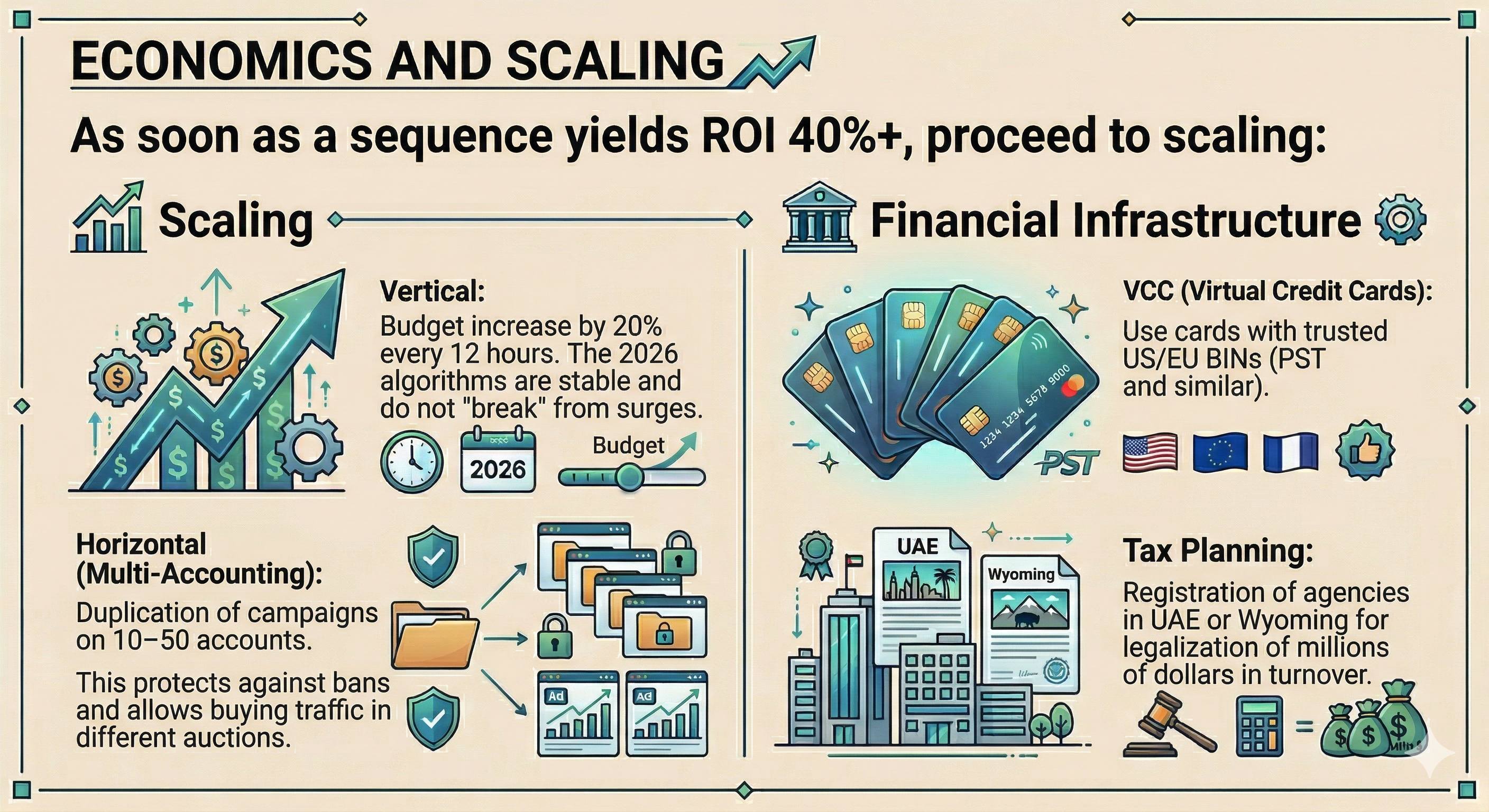
Chapter 7. Economics and Scaling
Once a "link" (campaign combo) yields an ROI of 40%+, move to scaling:
Vertical: Increasing the budget by 20% every 12 hours. 2026 algorithms are stable and don't "break" from jumps.
Horizontal (Multi-Accounting): Duplicating the campaign across 10–50 accounts. This protects against bans and allows buying traffic in different auctions.
Financial Infrastructure:
VCC (Virtual Credit Cards): Using cards with trusted US/EU BINs (PST and similar).
Tax Planning: Registering agencies in the UAE or Wyoming to legalize turnovers in the millions of dollars.
Chapter 8. Risks and Security
Compliance: The EU has introduced mandatory labeling for AI content. Violation leads to a lifetime ban.
Intellectual Fraud: Ad networks may mix in "smart bots" that mimic human behavior. Using anti-fraud tools (FraudScore) is mandatory.
Conclusion
Affiliate marketing in 2026 is not a "money button" but a complex technological marathon. The winner is the one who combines human creativity with the computational power of AI. To enter the market today, forget about manual settings—invest in software, data, and a team.
Top Tips:
Do not bet on a single source.
Invest in technical education (API, SQL, Cloud).
Build long-term funnels (Subscription, RevShare) rather than one-off "burn-and-churn" schemes.




Comments 0