
 EN
EN
 UK
UK
 RU
RU
 AR
AR
 BN
BN
 ZH
ZH
 DE
DE
 ES
ES
 FR
FR
 HI
HI
 ID
ID
 UR
UR
 PT
PT
 TR
TR
Contextual and targeted advertising allows you to get initial clicks and leads almost immediately after launch. However, having traffic does not guarantee sales and campaign profitability.
Some advertisers quickly find a working combination and gradually increase their traffic volume. Others face expensive clicks, low conversion rates, ad rejections, and rapid budget depletion.
The reason is not always high competition or a lack of funds. Often, money is lost due to mistakes made even before launching ads: technical unpreparedness of the project, lack of testing, a weak landing page, or incorrect result evaluation.
Let's break down five common mistakes and ways to reduce their impact on your advertising budget.
Mistake #1. Launching Ads Without Technical Preparation of the Project
When preparing a campaign, the main focus is usually on creatives, ad texts, and audience settings. The technical part of the project is often left in the background.
But even a strong promotional offer will not yield the expected result if the website works unstably, the order form does not send data, the page loads slowly, or it displays incorrectly on mobile devices.
Before launching, you must verify:
- functionality of the domain and SSL certificate;
- landing page load speed;
- correct display on smartphones;
- proper operation of forms, buttons, and links;
- lead transmission to the CRM, a messenger, or email;
- correct installation of tracking tags and analytics;
- availability of all pages the ads lead to.
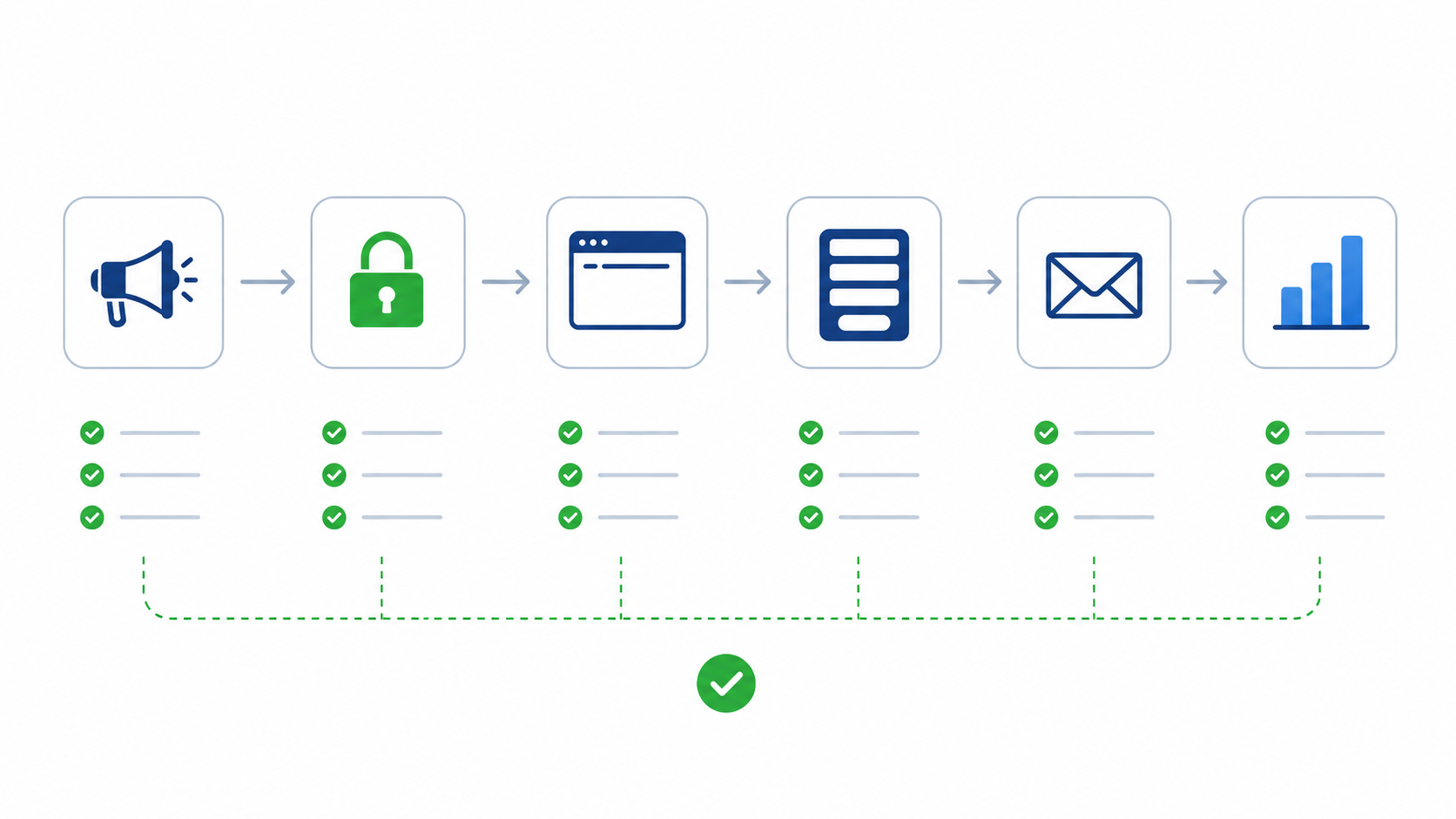
Scheme for checking the ad, domain, landing page, lead form, and analytics
It is also important to consider that advertising platforms analyze more than just the content of the ad. The moderation process and placement quality can be affected by the state of the domain, the content of the landing page, technical errors, and the website's compliance with platform requirements.
Therefore, an advertising campaign should be checked as a single mechanism: from the ad to the lead submission. If even one element works incorrectly, the advertiser pays for traffic that cannot properly convert into sales.
A brief technical audit before launch usually takes less time than subsequently fixing problems after the budget has already started draining.
Mistake #2. Scaling Before Gathering Statistics
The desire to rapidly increase the number of leads is understandable. However, a sharp budget increase in the first days of a campaign often leads to an accelerated depletion of funds rather than a growth in sales.
Until a sufficient amount of data is received, it is difficult to objectively determine key parameters:
- which audience responds best;
- which creative yields a higher CTR;
- how much customer acquisition actually costs.
Even an attractive offer needs to be tested. The result can depend on the ad format, image, headline, the way benefits are presented, or the call to action.
At the start, it is advisable to test several hypotheses:
- different segments of the target audience;
- multiple creative variations;
- different headlines and ad texts;
- several offers;
- different landing pages;
- various calls to action.
At the same time, you should not change all elements simultaneously. If you replace the audience, creative, text, and landing page all at once, it will be difficult to determine which specific change affected the result.
Approaches to testing and scaling campaigns change alongside the algorithms of advertising platforms. The video explains in detail how the Andromeda system in Facebook affects audience selection, work with creatives, and the launch of advertising campaigns.
Mistake #3. Ignoring Landing Page Quality
Even the most effective advertising campaign cannot compensate for the shortcomings of a weak landing page. A user might get interested in the ad and go to the website, but never complete the target action. As a result, the advertiser pays for clicks that do not bring sales or leads.
There can be quite a few reasons for this situation. Most often, users leave the page almost immediately after clicking due to technical or visual flaws on the site.
Today, a significant portion of users comes precisely from smartphones. If the site is inconvenient to view from a mobile device, the bounce rate increases several times over. This negatively affects not only the number of leads but also the efficiency of the entire advertising campaign.
In addition to user behavior, advertising platforms themselves evaluate landing page quality. The worse the user experience, the lower the ad quality score. As a result, the cost per click gradually increases, and the advertiser has to pay more for the same volume of traffic.
Before launching ads, it is recommended to independently go through the potential client's journey.
To do this, you must execute:
- Click on the advertisement.
- Check the website load speed.
- Review the offer.
- Try to submit a lead form.
- Check the correct operation of all forms.
- Ensure that the site works equally well on a computer and mobile devices.
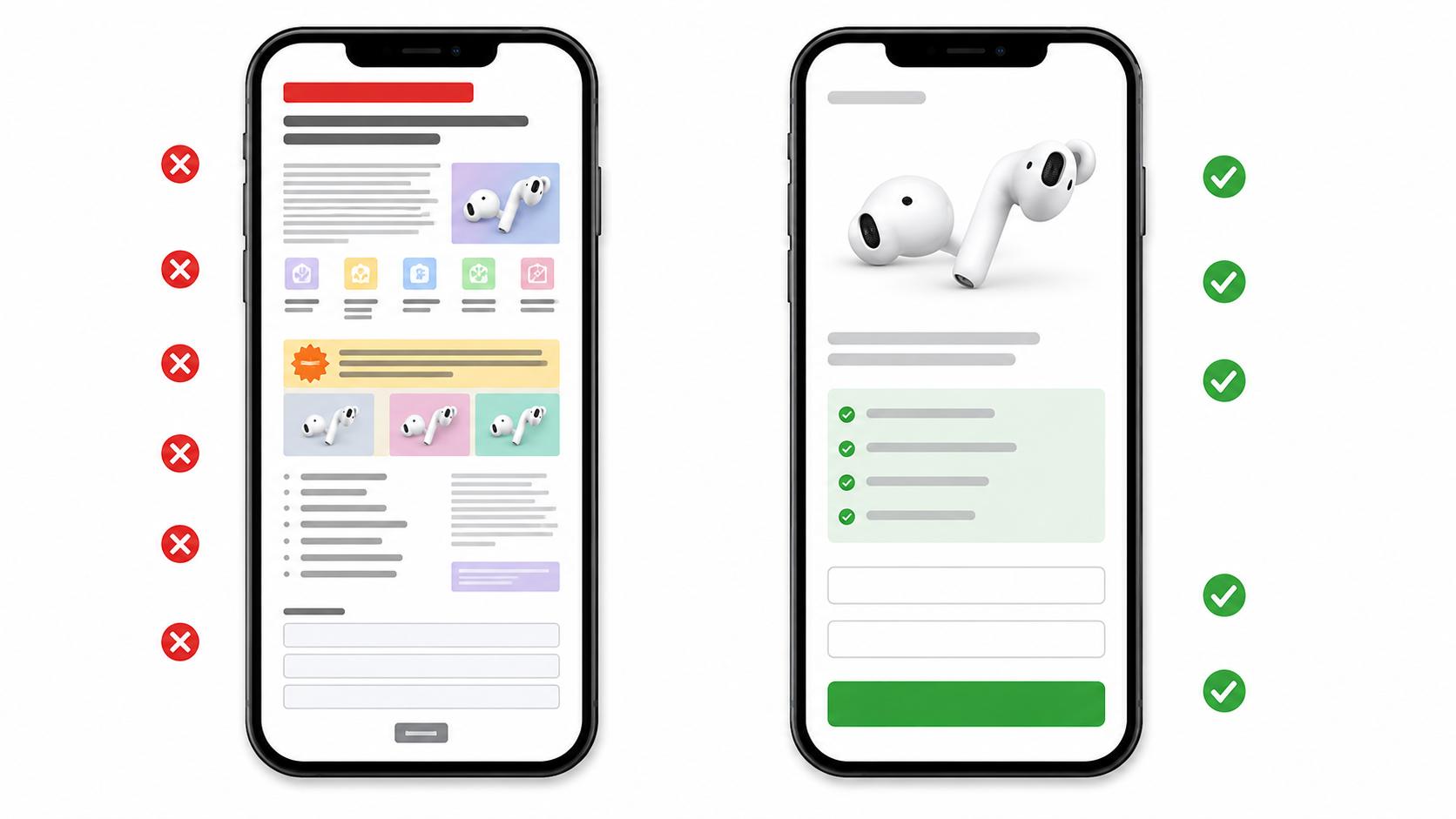
Comparison of an overloaded and an optimized mobile landing page
Even minor flaws can significantly reduce conversions. Sometimes, eliminating a few technical errors allows you to increase the number of leads without additionally increasing the advertising budget.
Mistake #4. Lack of Analytics and Relying on Guesswork
A large number of leads does not mean the campaign is working effectively. Cheap leads might not turn into sales, while a more expensive traffic source sometimes brings clients with a higher average check.
Therefore, the entire funnel must be analyzed:
impression → click → website visit → lead → confirmed order → sale.
To evaluate advertising campaigns, the following metrics are used:
- CTR — ad click-through rate;
- CPC — cost per click;
- CPL — cost per lead;
- landing page conversion rate;
- cost of a confirmed order;
- cost of a sale;
- average check;
- buyout rate;
- ROMI or ROI;
- total profit from the campaign.
Let's look at an example. Two campaigns brought in 100 leads each. In the first one, the cost per lead was $5, and in the second — $7.
If you look only at the CPL, the first campaign seems more profitable. But after processing the orders, it might turn out that the first campaign resulted in 10 sales, while the second resulted in 25.
In this case, the cost of a sale will be:
- first campaign — $50;
- second campaign — $28.
Despite the more expensive lead, the second campaign turns out to be more effective for the business.
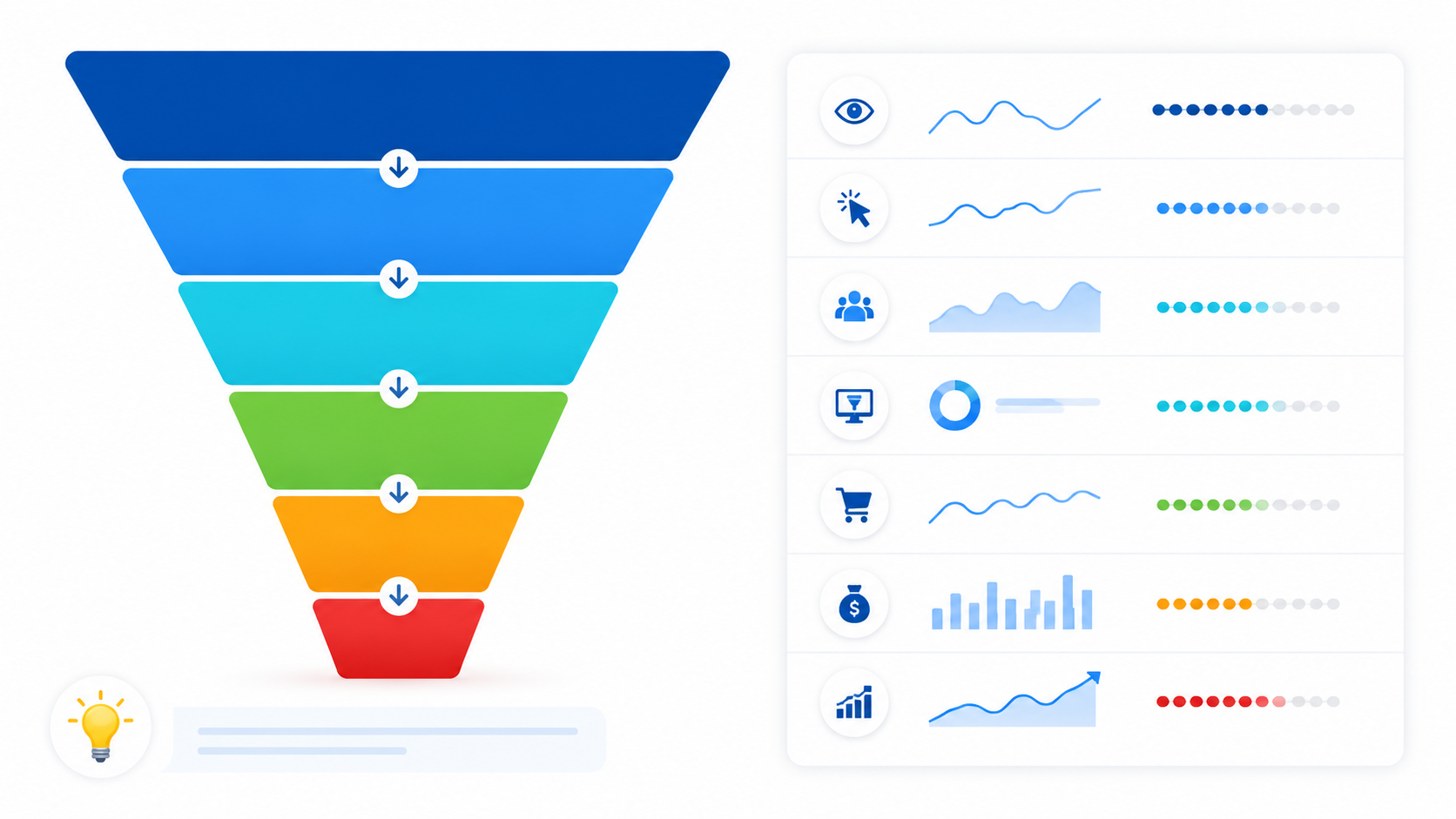
Advertising campaign funnel from ad impression to lead and sale
Therefore, it is advisable to compare data from the advertising cabinet with information from the CRM or another order accounting system. This helps to understand not only the source of the lead but also its further outcome.
Optimization decisions must also be made based on statistics. Changing the audience, creative, display schedule, or landing page must be accompanied by recording the results.
Without analytics, advertising turns into a set of assumptions. With analytics, it becomes a manageable process where you can find weak points and gradually increase profitability.
Mistake #5. Saving on Professional Tools
At the start, one specialist can independently monitor several campaigns, check links, change settings, and track results in spreadsheets.
But as the number of projects grows, manual management becomes a source of additional risks.
Difficulties arise with:
- distributing traffic between pages;
- changing transition scenarios;
- working with different geographical regions;
- checking a large number of links;
- transferring tasks between employees;
- recording changes;
- maintaining unified workflows.
When every employee works according to their own algorithm, the probability of errors, data loss, and uncoordinated changes increases.
Therefore, when scaling, it is important to determine in advance:
- who is responsible for technical settings;
- where changes are recorded;
- how advertising links are checked;
- how traffic is distributed;
- what rules are used for different projects;
- how the team acts when an error is detected.
Specialized tools can be used to manage visitor flows. For example, LP-Cloak allows you to set up filtering and traffic distribution rules taking into account the user's country, device, operating system, browser, referral source, and other parameters.
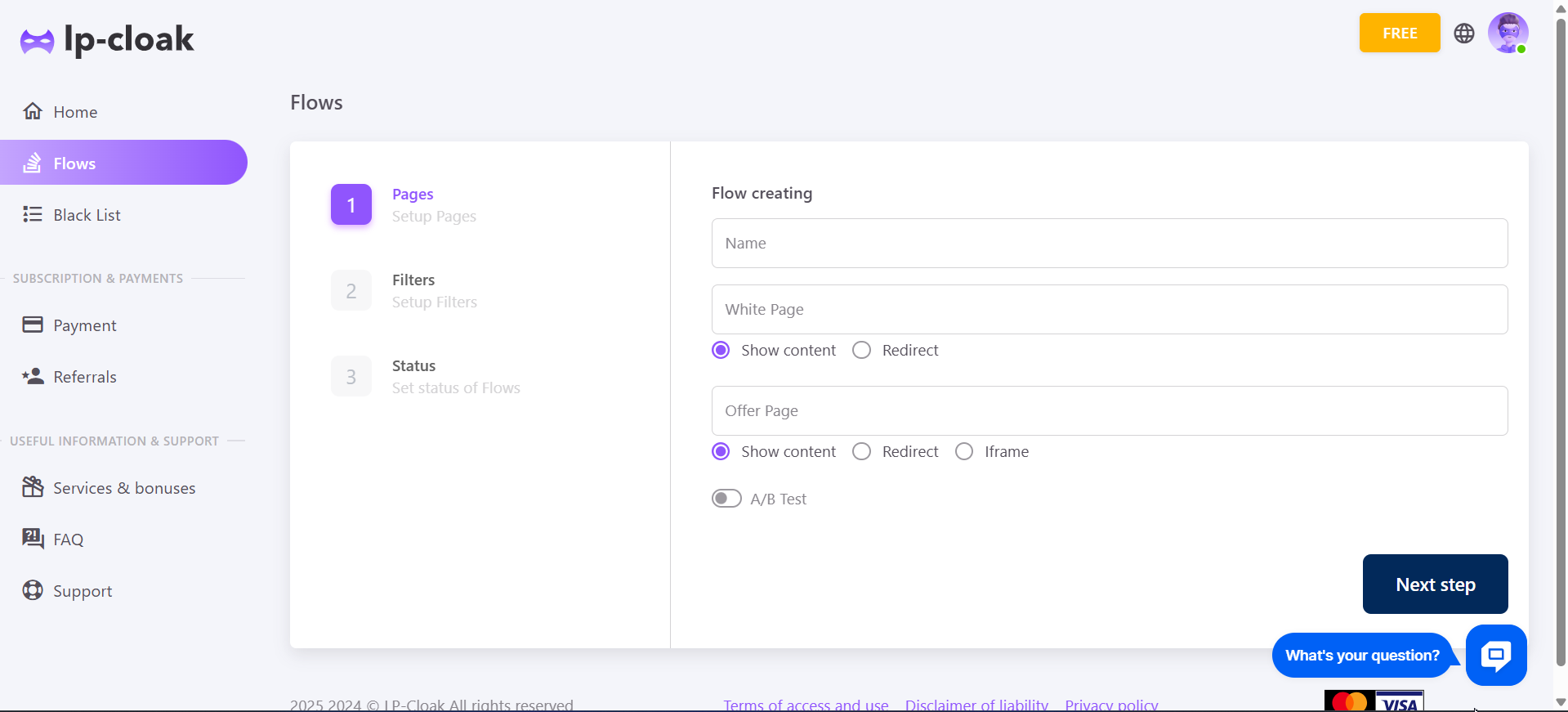
Cloak setup
The service also helps filter bots and unwanted clicks, and with the help of A/B testing — distribute visitors among multiple versions of landing pages. This makes it possible to compare different variations of landing pages, automate part of the technical operations, and change traffic routing scenarios faster without constant manual control.
Such a tool can be useful for agencies, media buying teams, and specialists who simultaneously work with several projects. At the same time, LP-Cloak does not replace analytics, high-quality creatives, and compliance with advertising platform requirements, but rather helps to more conveniently manage the technical part of advertising campaigns.
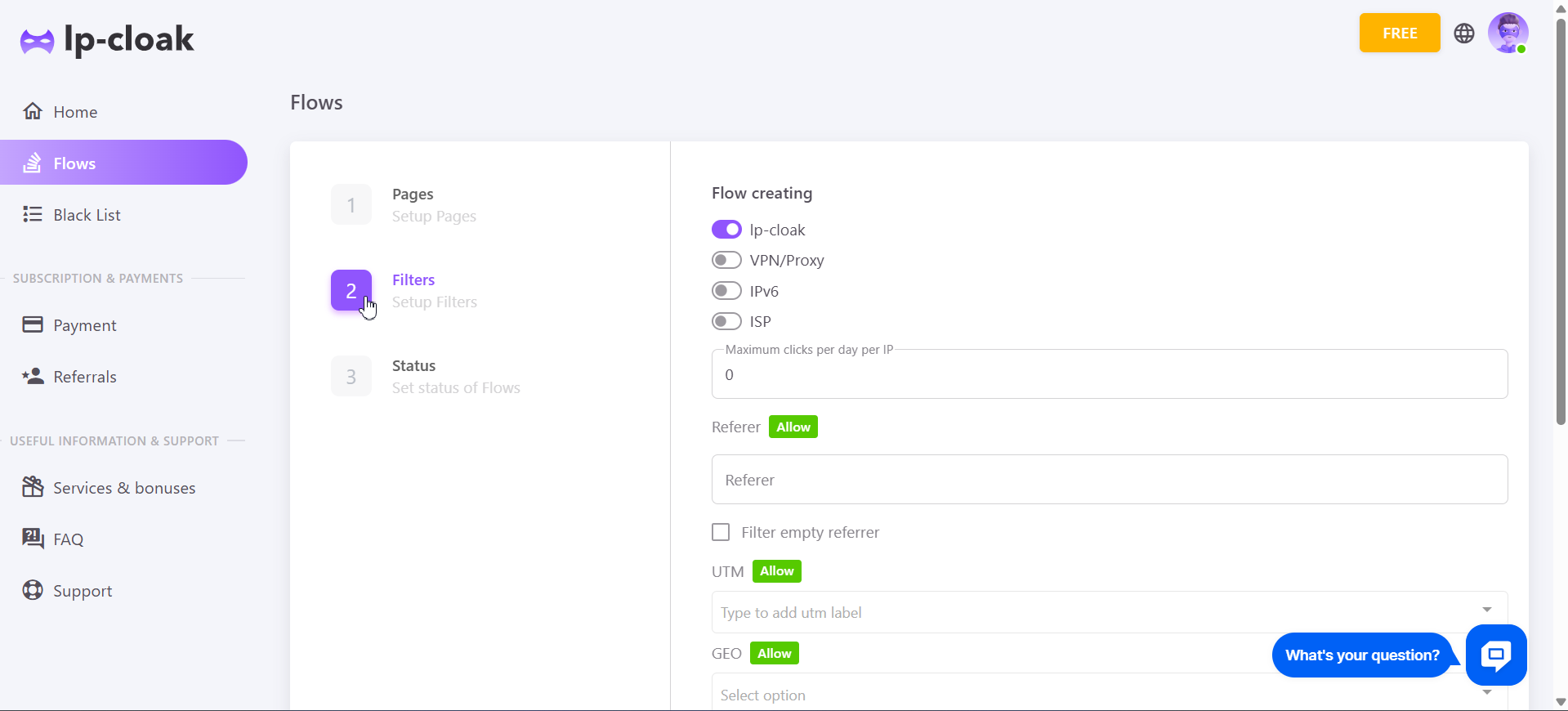
Filtering and traffic distribution rules in the cloak
Furthermore, any service remains only a part of the infrastructure. It does not replace high-quality creatives, analytics, testing, and compliance with advertising platform requirements.
How to Prepare an Advertising Campaign for Launch
To reduce the probability of unnecessary expenses, it is recommended to go through a small checklist before launching:
- Check the offer
The user must quickly understand:
what is being offered to them;
what benefit they will receive;
how much the product costs;
why they should choose this exact offer;
what action needs to be taken. - Prepare multiple creatives
You should not rely on just one image or video. It is advisable to create several variations in advance that differ in presentation, visuals, and the main message. - Test the landing page
You need to check the mobile version, load speed, forms, buttons, links, and lead transmission. - Set up analytics
Before launch, clicks, leads, purchases, and other target actions must be recorded correctly. - Define KPIs
You must set the acceptable cost in advance for:
a click;
a lead;
a confirmed order;
a sale.
This will help determine faster which campaigns should be optimized or turned off. - Start with a test budget
The first stage is needed not for the maximum number of sales, but for gathering information and testing hypotheses. - Standardize the workflow
If a team is working with the ads, you need to determine the responsible persons, the rules for making changes, and the procedure for checking campaigns.
Why Prevention is Always Cheaper Than Fixing Mistakes
When an advertising campaign has already encountered serious problems — account suspension, ad rejection, loss of statistics, or unsuccessful scaling — restoring previous metrics requires time, additional resources, and new expenses.
Often, you have to practically rebuild the advertising strategy from scratch, test audiences, update creatives, and look for the reasons behind the drop in efficiency. All of this ends up being significantly more expensive than the timely preparation of the project.
That is exactly why professionals pay special attention to prevention. A properly built infrastructure, regular data analysis, continuous testing, and the automation of technical processes help avoid most problems even before launching ads.
This approach allows you to make advertising campaigns more stable, reduce the number of technical errors, and more effectively use every budget invested in promotion.
Conclusion
High advertising costs are not always associated with expensive clicks or high competition. Often, the budget is lost due to technical unpreparedness, a lack of testing, a weak landing page, and an incorrect evaluation of results.
An effective advertising campaign is not built around a single successful ad. It includes a high-quality offer, a stable technical infrastructure, a convenient landing page, configured analytics, and consistent scaling.
As the number of projects grows, special attention should be paid to traffic flow management and the internal processes of the team. Specialized solutions, including LP-Cloak, can be used to automate some of these tasks.
However, the core principle remains unchanged: first, you must verify the performance of the entire advertising combination, obtain data, and only then increase the budget.






Comments 0