
 EN
EN
 UK
UK
 RU
RU
 AR
AR
 BN
BN
 ZH
ZH
 DE
DE
 ES
ES
 FR
FR
 HI
HI
 ID
ID
 UR
UR
 PT
PT
 TR
TR
In traffic arbitrage, the technical side relies on three key elements: an anti-detect browser, proxies, and spy services. The anti-detect browser is responsible for the safe operation of accounts, proxies handle network isolation and GEO, and spy services are used for finding and analyzing profitable campaigns (or funnels).
But before moving on to specific tools, it is necessary to understand the basic questions faced by almost all specialists working with multi-accounting.
Why is a regular browser not enough for working with multiple accounts?
Regular browsers were originally created for a single user working on a single device. Therefore, all accounts opened within such a browser inevitably leave the same digital footprint of the device, network parameters, system configuration, and the browser itself.
Even if a user tries to separate accounts using a VPN or incognito mode, most of the parameters remain the same. Anti-fraud systems easily match such data and link the accounts together. As a result, platforms can limit the functionality of the accounts or ban them completely.
That is exactly why special tools—anti-detect browsers—are used for working with a large number of accounts.
How do websites determine that a user is working through an anti-detect browser?
Modern platforms use complex anti-fraud systems. They analyze dozens and even hundreds of device parameters: IP address, operating system, browser version, Canvas, WebGL, WebRTC, time zone, system language, screen resolution, and many other characteristics.
But checking individual parameters is only part of the system. Algorithms also evaluate how logically these parameters match each other. For example, a mismatch between the operating system, video card, and browser can become a signal for additional verification.
Therefore, a high-quality anti-detect browser must not just spoof individual parameters, but form a realistic (consistent) digital environment that looks natural to anti-fraud systems.
What tasks are most often solved using anti-detect browsers?
Anti-detect browsers are used in various areas of internet marketing and online business where working with multiple accounts is required.
The most common tasks include:
Managing a large number of advertising accounts;
Separating test campaigns and funnels;
Working with accounts in different GEOs;
Reducing the risk of mass bans;
Safely transferring accounts within a team.
Essentially, an anti-detect browser becomes software that allows you to scale your work without the risk of losing accounts.
What automation features should a modern anti-detect browser have?
As the number of accounts grows, manual work becomes too slow and inefficient. Therefore, modern anti-detect browsers offer automation tools that help speed up routine processes.
Key features include:
Action synchronization between profiles;
Automated scripts for repetitive tasks;
Account warm-up tools;
Mass profile management;
Team access and role distribution.
Such features allow you to work not with dozens, but with hundreds and thousands of profiles without significantly increasing the load on the team.
Now that we have covered the basic principles of how anti-detect browsers work, we can move on to a specific tool and see how these tasks are implemented in practice. One of the most popular solutions on the market is Dolphin Anty.
This anti-detect browser allows you to manage the digital footprint and create independent browser profiles. To platforms, each such profile looks like a separate user with their own device and digital environment. This reduces the risk of accounts being linked and subsequent sanctions for multi-accounting.
Key features of Dolphin Anty
Dolphin Anty is built on the Chromium engine, which is regularly updated. Therefore, profiles launched in it are almost indistinguishable from a regular Chrome browser, both visually and functionally.
The interface of the anti-detect browser itself is also intuitive: profile management takes place in several windows. The first of them is "Browser profiles", where they are created. After clicking the "Create profile" button, a window opens where the digital footprint is configured. The closest attention is paid to its management. Dolphin Anty allows you to configure and randomize parameters, reducing the risk of linking profiles.
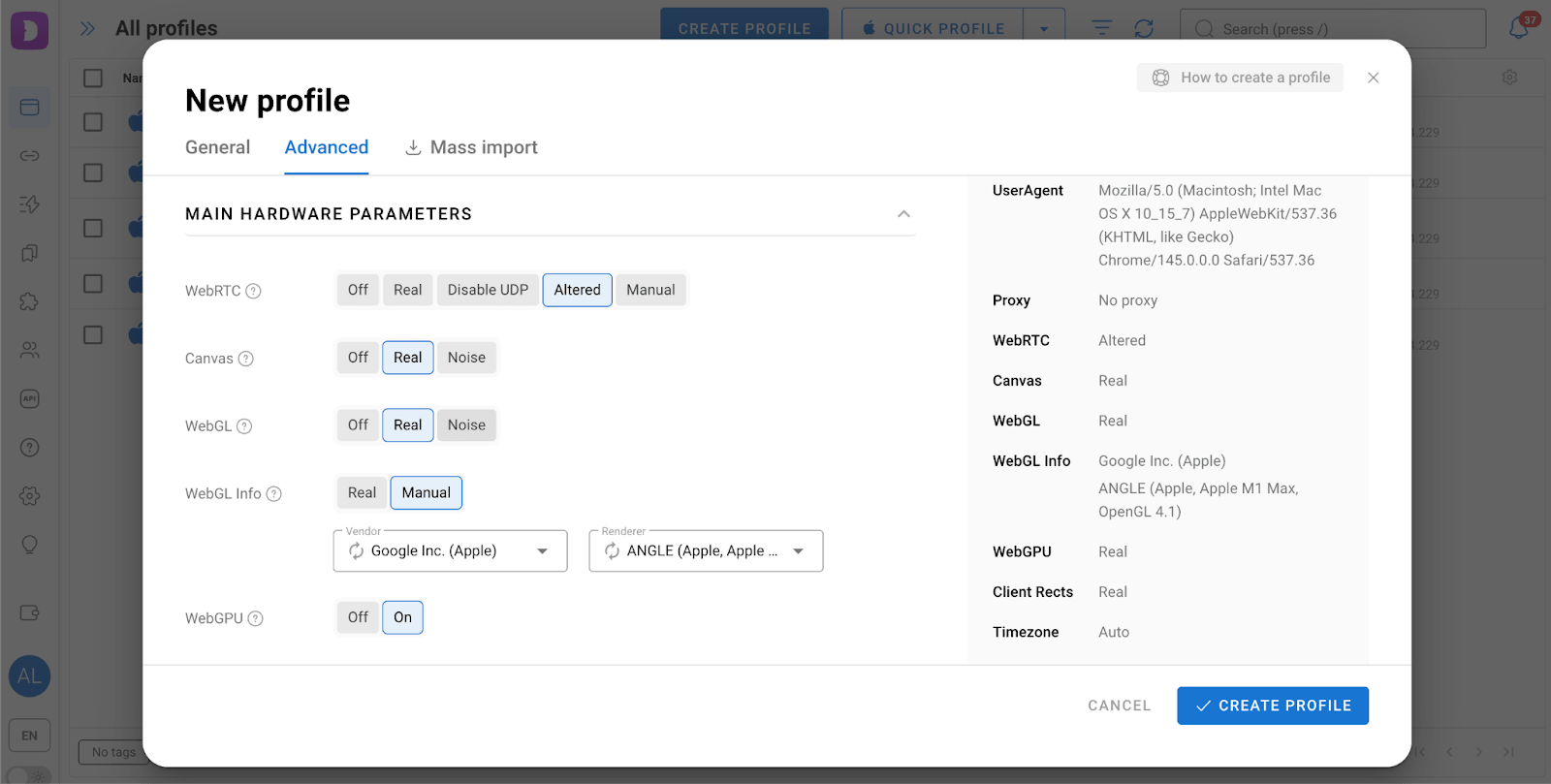
Manual footprint configuration is recommended for experienced users who know exactly how to set it up so that individual parameters do not contradict each other. For beginners, an automatic mode is provided, where parameters are selected in such a way as not to arouse the suspicion of anti-fraud systems.
There are also unique features. For example, device name spoofing, which is useful when working with platforms with powerful anti-fraud systems, where even minor discrepancies can lead to a ban.
When there are many profiles, finding the right one can be difficult. Dolphin Anty has the ability to group profiles into folders and assign statuses and tags to profiles, by which they can then be grouped.
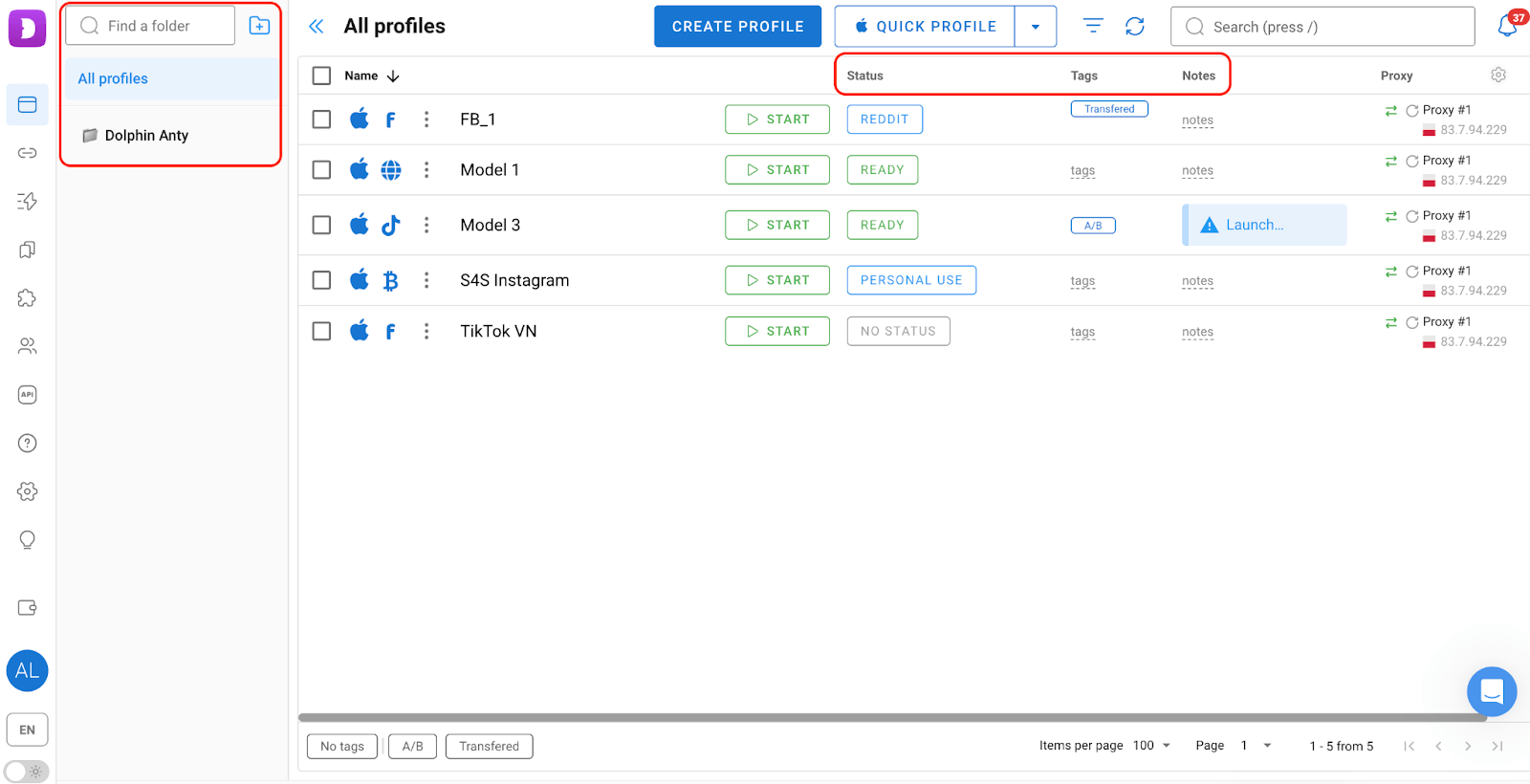
If this is not enough for quick navigation, there is an option to add a short note to a profile and describe what it is for. Notes can be customized with colors and special symbols.
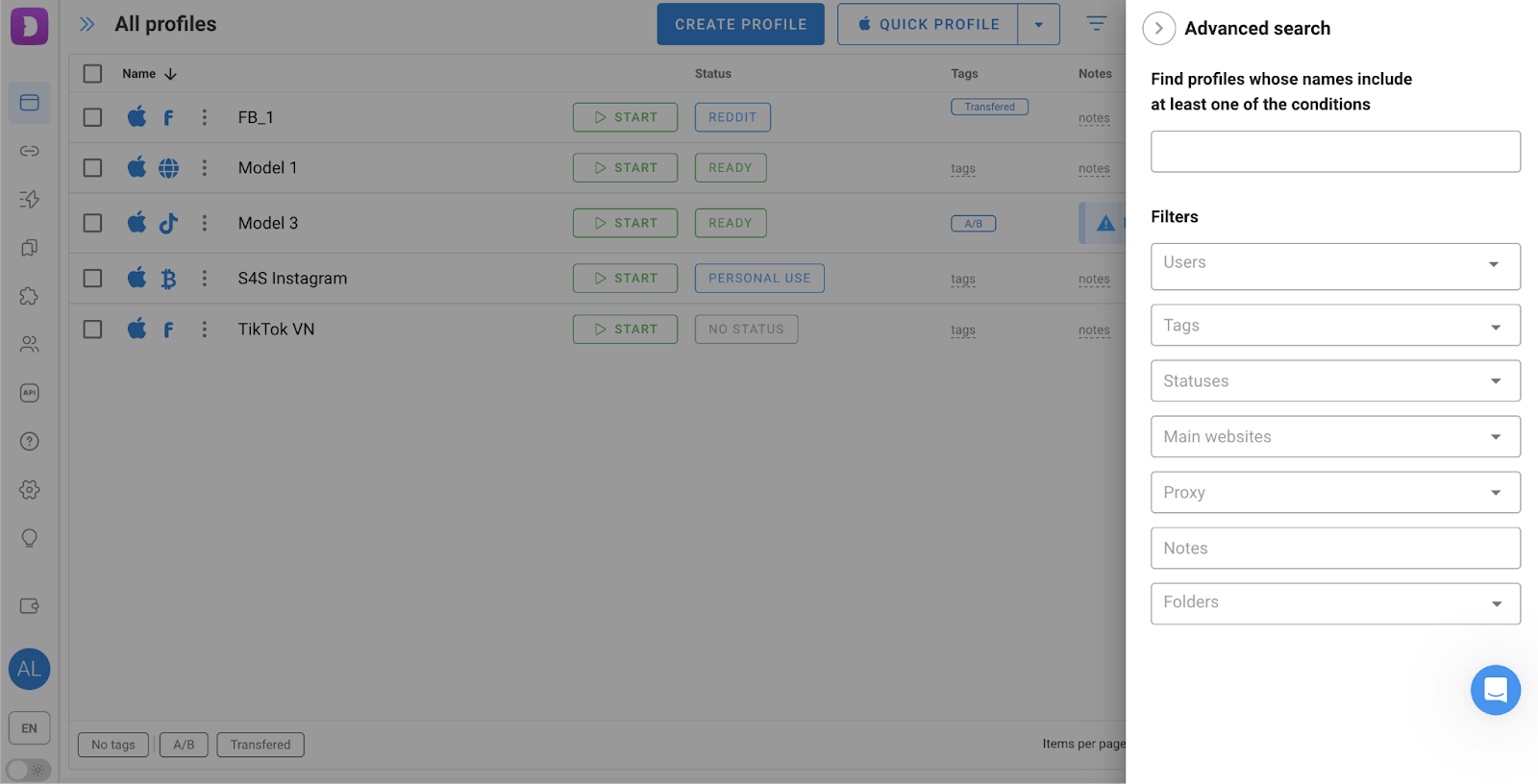
In addition, there is an advanced filter system that will allow you to find the right profile in a matter of seconds.
Proxies in Dolphin Anty
Proxies are the second critically important element in traffic arbitrage after the anti-detect browser. They are what set the profile's IP, GEO, and network environment. Incorrectly selected or reused proxies are one of the main reasons for account bans.
In Dolphin Anty, proxies are assigned in two ways.
The first is at the profile level. This means that when an account is created, a proxy can be assigned to it in a separate block.
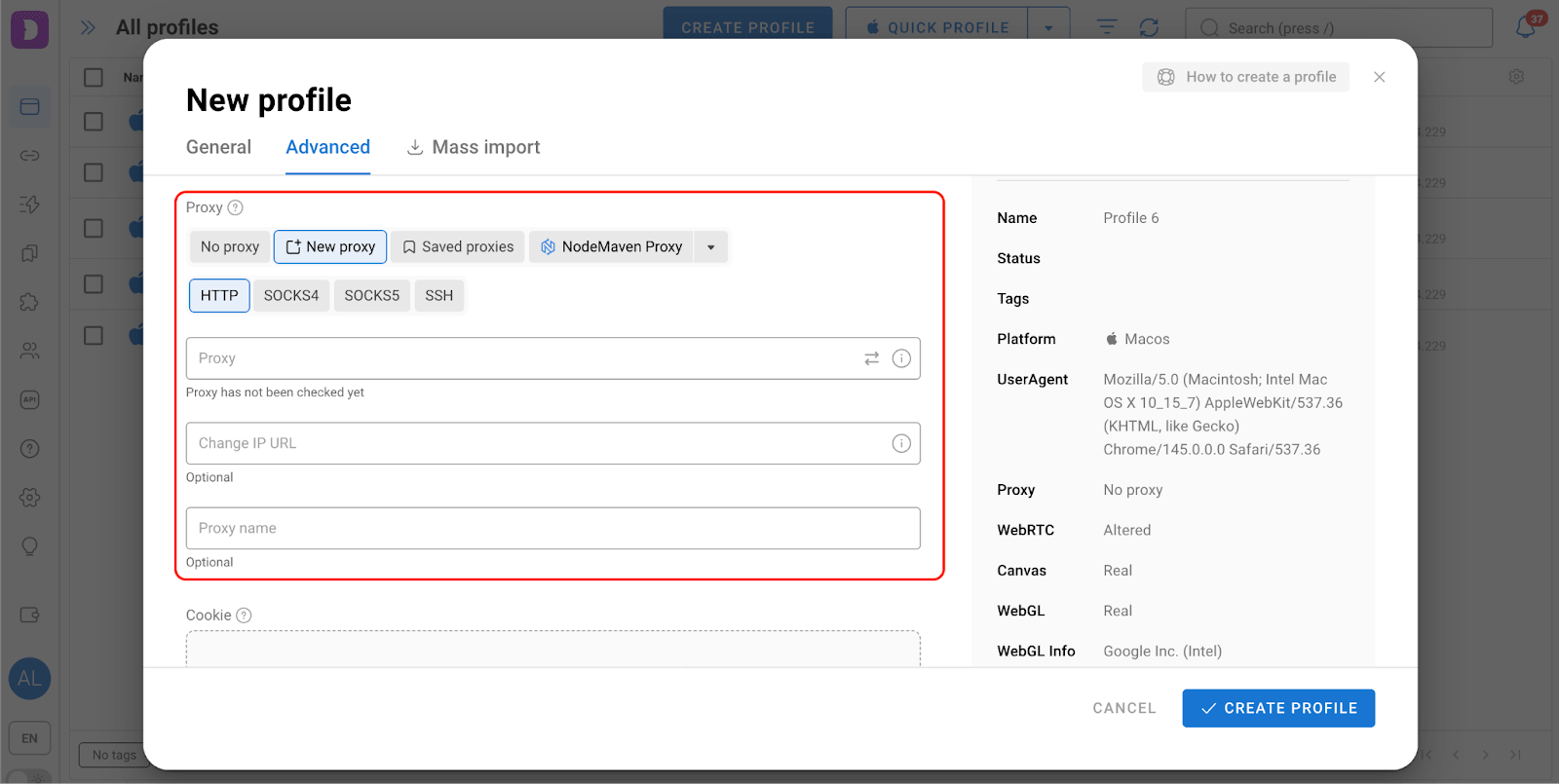
The second method allows you to add proxies in a separate menu and use them later, for example, if you need to assign them to specific accounts. Here you also have the ability to add proxies in bulk. If you have any questions, there is a tooltip with acceptable formats.
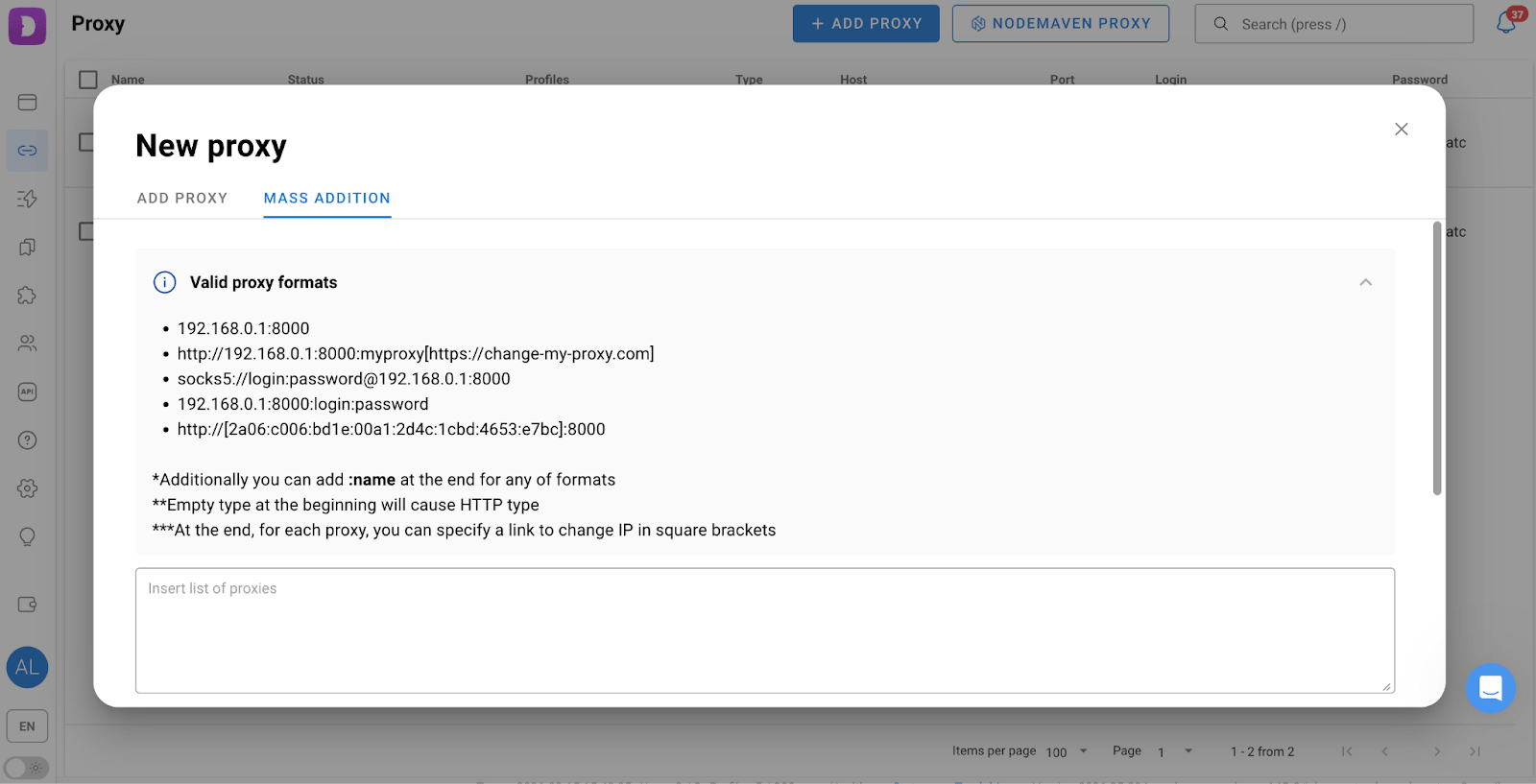
Do not forget about the basic principles of safely working with proxies:
1 profile — 1 proxy;
Do not use server proxies to launch advertising campaigns;
Do not change the proxy within a profile after starting work;
Select the proxy type according to the traffic source: mobile for social networks and strict anti-fraud, residential for most advertising platforms, server for less sensitive sources.
Dolphin Anty supports all major types of proxies and checks their availability upon connection. This helps to avoid a situation where a profile is launched with an invalid IP, which is a frequent cause of bans by anti-fraud systems.
The combination of an anti-detect browser and high-quality proxies allows you to create a stable environment where accounts do not intersect either by footprints or by network characteristics.
Automation and workflows
As the number of accounts grows, manual work becomes too costly. Dolphin Anty has tools that automate routine tasks and simplify profile management.
Key features:
Synchronizer — repeats actions from the main profile in others in real-time. Convenient for bulk and repetitive operations.
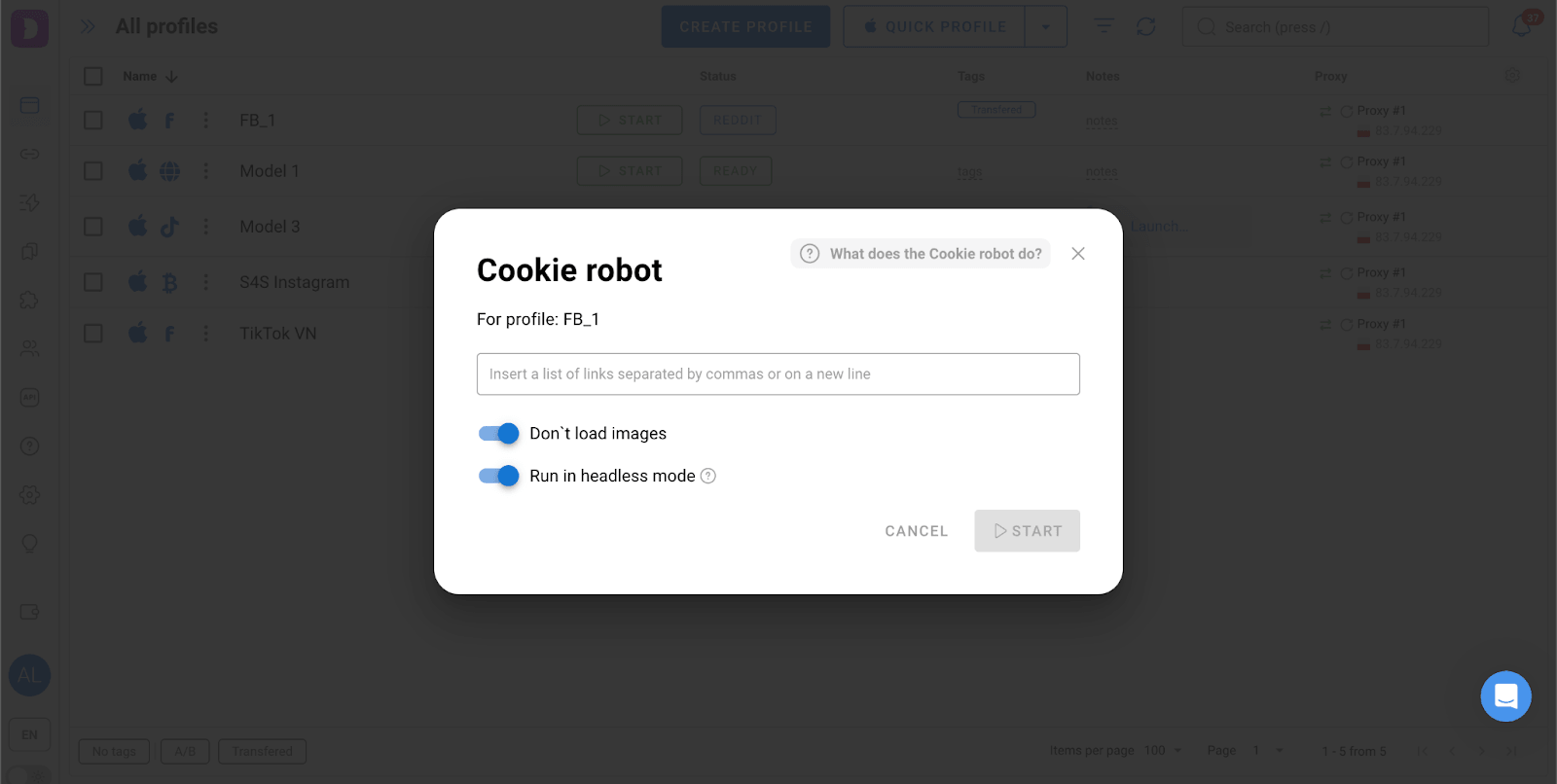
Scripts — automated sequences of actions that are created on an interactive map without programming skills. Suitable for warming up accounts and simulating the behavior of a real user.
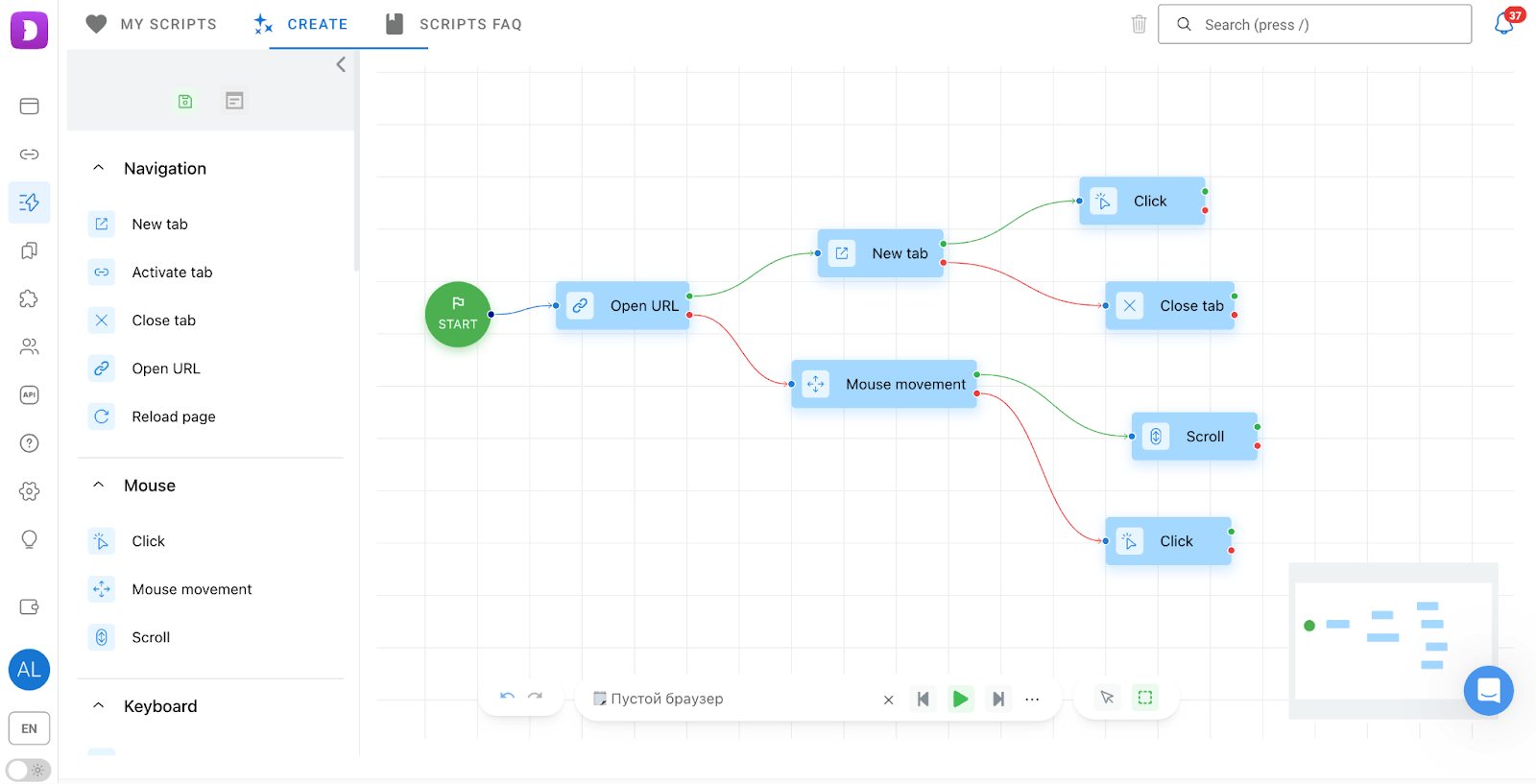
Cookie robot — collects cookies to warm up profiles. It can work in the background and without loading images. This is important when working through proxies that charge for traffic.
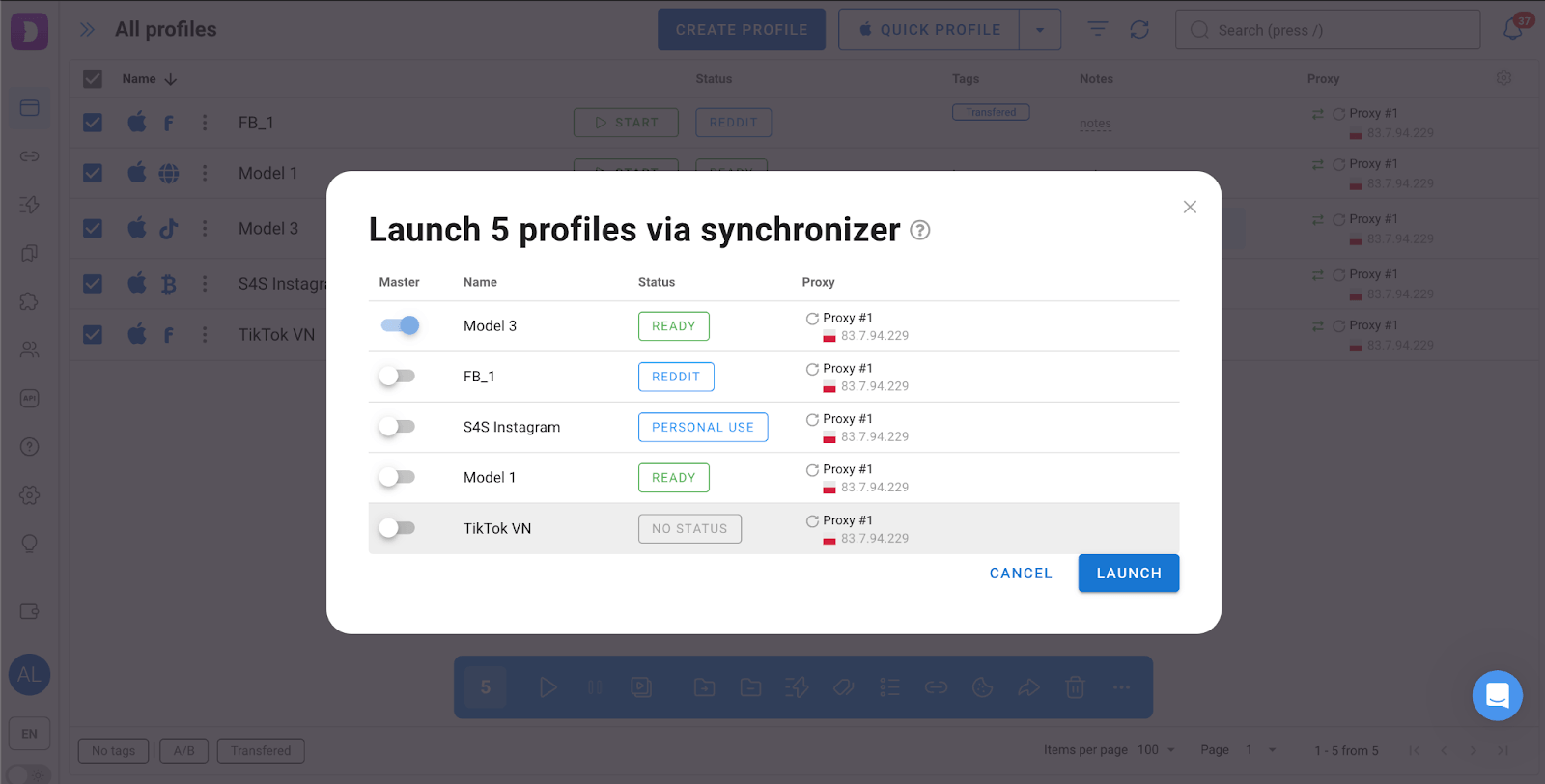
For teamwork, there are roles, access delimitation, and data sharing. This reduces the risk of errors when transferring accounts and simplifies coordination within the team.
Where is Dolphin Anty used?
Anti-detect browsers are in demand not only in traffic arbitrage but also in verticals with high requirements for anonymity and account stability. This is especially noticeable in gray verticals: crypto and nutra, where platforms actively apply anti-fraud algorithms, and bans are possible even with the correct promotion of offers.
Separating accounts via individual profiles allows you to:
Isolate campaigns;
Test funnels faster;
Scale without the risk of mass bans;
Localize risks so that the ban of one account does not drag down the rest.
In this context, Dolphin Anty acts as the technical foundation of traffic arbitrage.
How anti-detect browsers and spy services complement each other
In traffic arbitrage, a spy service and an anti-detect browser solve different but interconnected tasks.
The spy service is responsible for:
Searching for creatives and funnels;
Analyzing competitors' funnels;
Selecting GEOs and offers;
Hypotheses for testing.
The anti-detect browser is responsible for:
Safe launch of accounts;
Scaling;
Isolation of tests;
Stability of the campaign run.
Thus, the spy service generates ideas and strategies, while the anti-detect browser provides the infrastructure in which these strategies can be safely implemented.
Dolphin Anty Pricing
Dolphin Anty is available in several pricing plans, from completely free to enterprise. This allows you to start by testing its capabilities and gradually scale as volumes grow.
Free — $0/month, up to 5 profiles with no time limits;
Starter — from $10/month, up to 60 profiles;
Base — $89/month, 100 profiles and adding users;
Team — $159/month, up to 300 profiles and team functions;
Enterprise — from $299/month, 1000+ profiles and scaling.
In addition, custom plans are available for large projects and agencies.
Conclusion
Dolphin Anty is an anti-detect browser for multi-accounting under the constraints of advertising platforms. It combines a user-friendly interface, flexible configuration of profiles and proxies with automation tools that are especially useful when scaling. In conjunction with a spy service, Dolphin Anty forms a foundation with which you can test, launch, and develop profitable campaigns without constant bans.






Comments 0