
 EN
EN
 UK
UK
 RU
RU
 AR
AR
 BN
BN
 ZH
ZH
 DE
DE
 ES
ES
 FR
FR
 HI
HI
 ID
ID
 UR
UR
 PT
PT
 TR
TR

The Era of "Intellectual Abundance": How to Earn Money Online in 2026
The world has entered the era of "intellectual abundance." While in the early 2020s, online earnings were associated with simple services like reselling goods or basic copywriting, by 2026, the rules of the game have changed completely. Artificial Intelligence has ceased to be a tool for enthusiasts and has transformed into the primary engine of profit. Today, the winner is not the one who "works hard," but the one who effectively orchestrates neural networks.
In this article, we will break down the structure of the AI-driven earning industry, identify which niches provide solid income, and explain how a beginner can enter this market when the barrier to entry seems deceptively low, yet the competition is colossal.
Chapter 1. Visual Capital: From Pixel Generation to High Tickets
Visual content has always been the most expensive niche on the internet. Previously, creating a high-quality video or a set of illustrations required a team of 5–10 people. In 2026, this cycle closes on a single "AI Creative Director."
1.1. Generative Art for Business
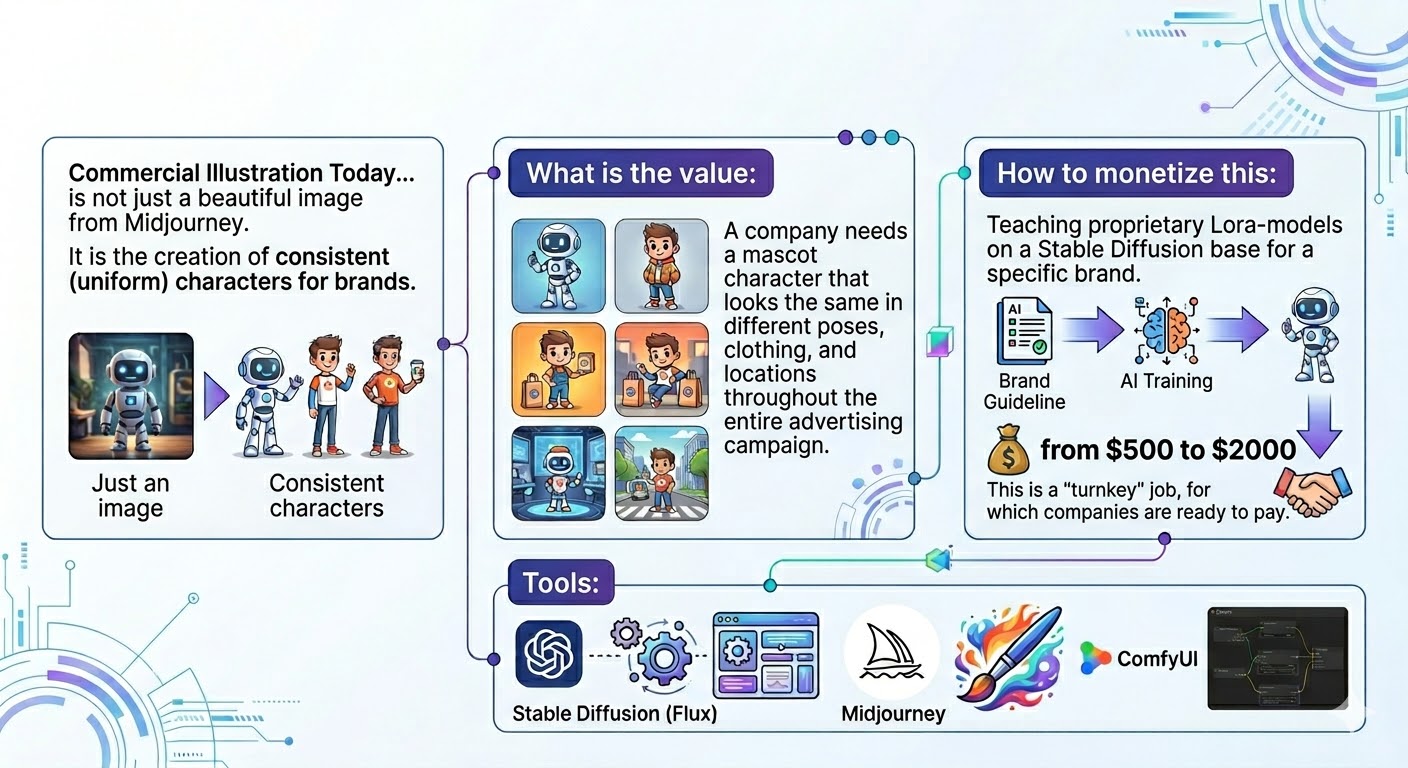
Commercial illustration today is more than just a pretty picture from Midjourney. It is about creating consistent characters for brands.
The Value: Companies need a mascot character that looks identical across different poses, outfits, and locations throughout an entire advertising campaign.
How to Monetize: Training custom LoRA models based on Stable Diffusion for specific brands. This is "turnkey" work for which companies are willing to pay from $500 to $2,000.
Tools: Stable Diffusion (Flux), Midjourney (Personalization), ComfyUI.
1.2. Video Production: The New Television
Video is the king of traffic. In 2026, video generation technologies (such as Sora or Kling) have reached a level where it is almost impossible to distinguish AI from reality.
The Niche: Creating advertising creatives for marketplaces and social media without actual filming. You take a product photo and, using AI, animate it, create a dynamic background, and overlay a voiceover.
Income: A single 15-second clip starts at $150. A professional editor using AI tools can produce up to 10 such clips per day.
Chapter 2. The Text Industry: From "Writing" to "Engineering"
Forget about copywriting exchanges that pay per character count. In 2026, characters cost nothing—AI generates them in milliseconds. Money is paid for meaning and results.
2.1. Prompt Engineering as Consulting
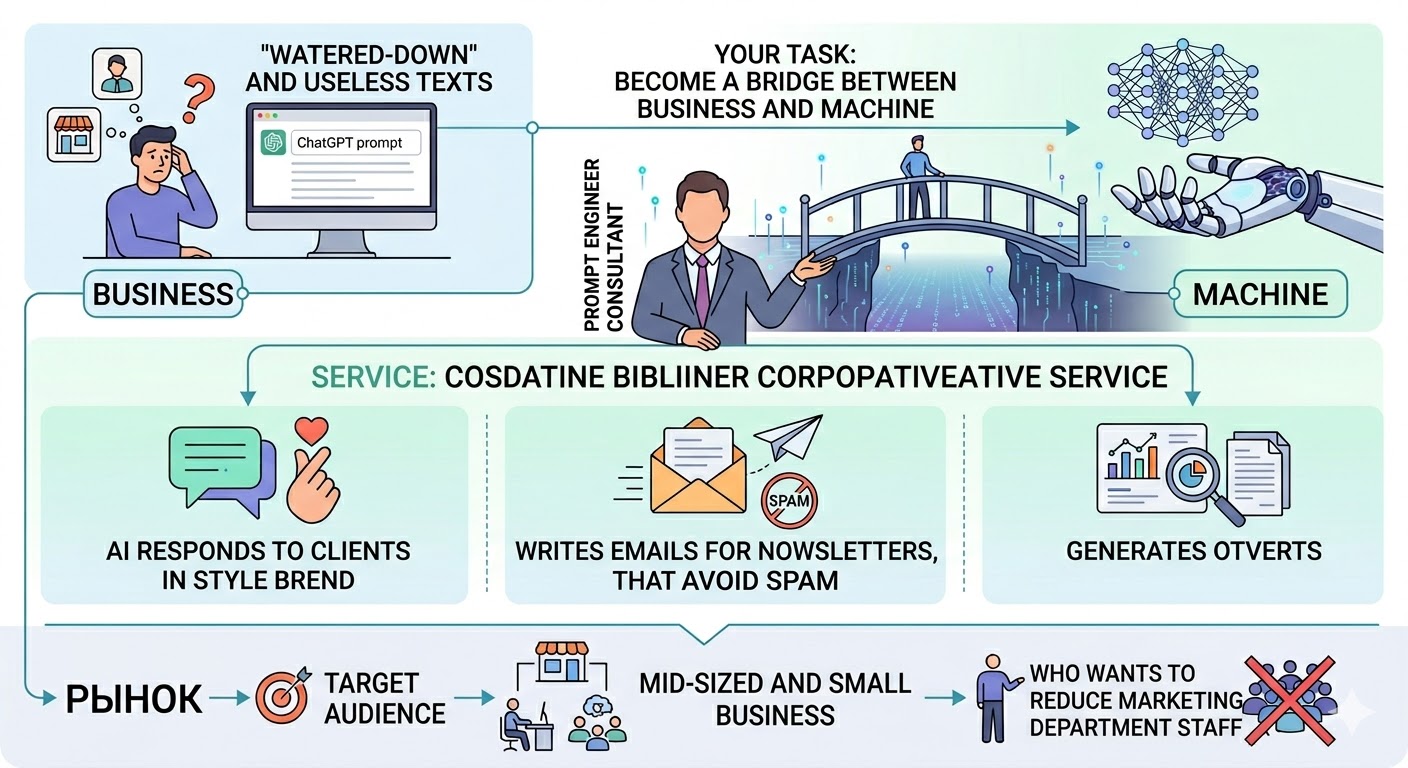
Many entrepreneurs have purchased ChatGPT subscriptions but receive "watery" and useless texts. Your task is to become the bridge between the business and the machine.
The Service: Creating a library of corporate prompts. You define the logic by which the AI will respond to clients in the brand's style, write newsletters that avoid spam filters, and generate reports.
The Market: Small and medium-sized businesses looking to downsize their marketing departments.
2.2. Automated Media Empires
Today, one person can manage a network of 20 thematic websites or Telegram channels.
The Mechanics: Setting up a Pipeline where one neural network monitors news, a second writes an analytical post, a third selects an illustration, and a fourth adapts the content for different platforms (SEO, social media, video).
Monetization: Direct advertising and affiliate programs. With 90% of processes automated, the marginality of such a business approaches 100%.
Chapter 3. Technological Earnings: Custom GPTs and AI Agents
This is the most high-tech and profitable niche. In 2026, "agents" have become the standard. An agent is not just a chat; it is an AI-based program that has access to tools: email, calendars, and CRM systems.
3.1. Developing Niche AI Assistants
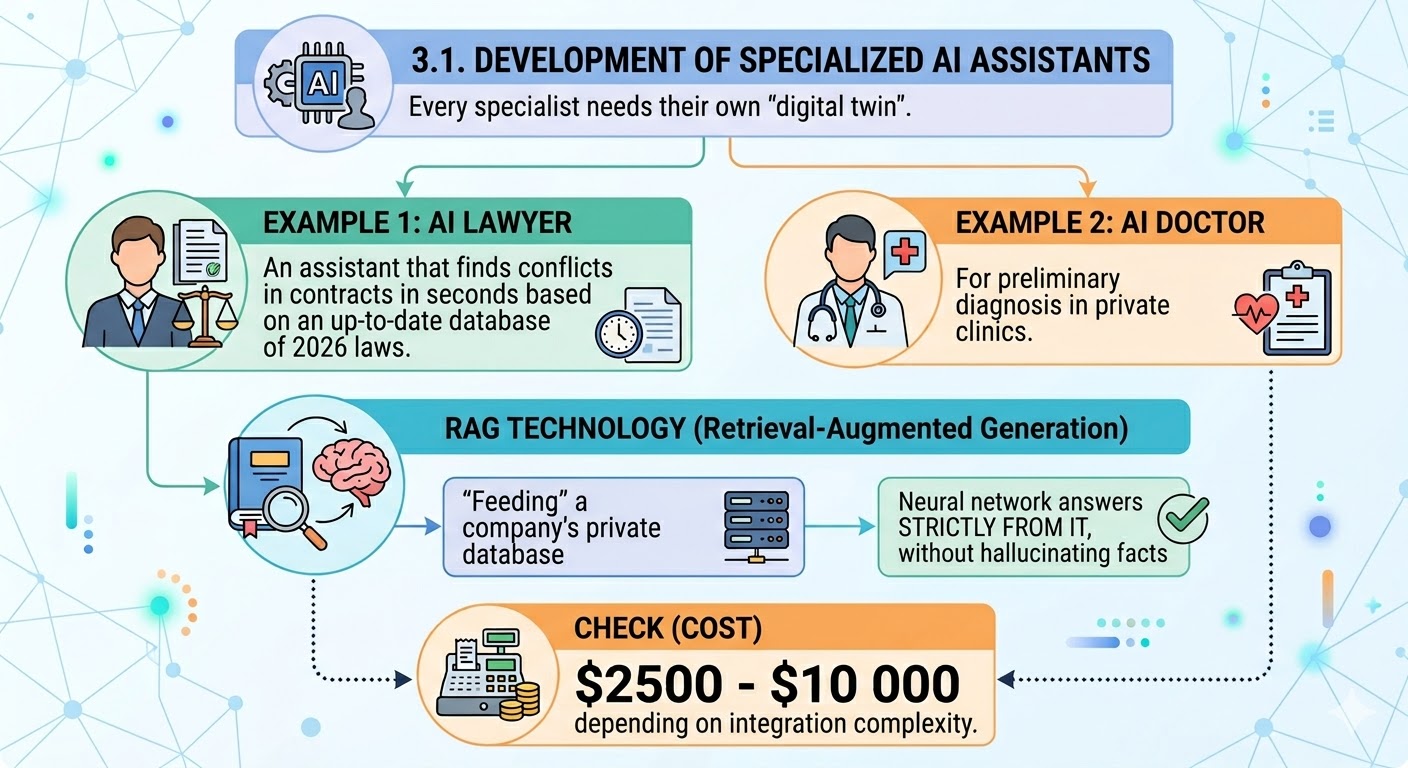
Every specialist needs their own "digital twin."
Example: An AI assistant for a lawyer that finds contradictions in contracts within seconds based on the current 2026 legal database. Or an AI doctor for preliminary diagnostics in private clinics.
RAG Technology (Retrieval-Augmented Generation): You "feed" a neural network a company's private database, and it answers strictly based on that data without hallucinating facts.
The Price Tag: Developing and implementing such a system costs from $2,500 to $10,000 depending on the integration complexity.
3.2. "SaaS on the Fly" (No-code + AI)
Thanks to AI, the barrier to entry for programming has vanished. Now you can ask a neural network to write code for a micro-service (e.g., a service for automatic background removal in videos or a Zoom call summarizer).
Earnings: Subscription model (SaaS). You create a useful utility that solves one specific client pain point and charge $9/month. With 1,000 users, that is $9,000 in passive income.
Chapter 4. New Professions: Who Is in Demand in 2026?
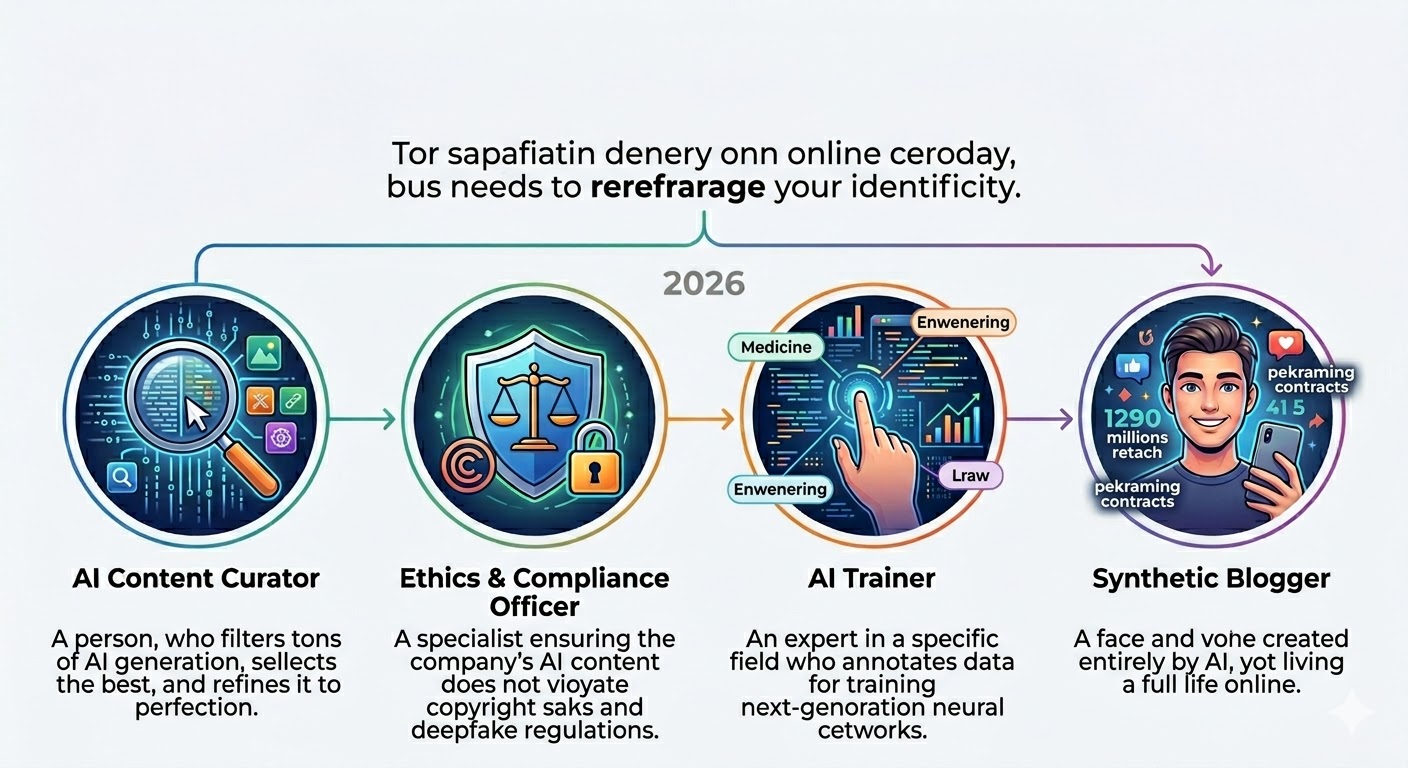
To earn money online today, you must redefine your identity. Here is a list of relevant roles:
AI Content Curator: A person who filters tons of AI generation, selects the best, and polishes it to perfection.
Ethics & Compliance Officer: A specialist ensuring that a company's AI content does not violate copyrights or deepfake laws.
AI Trainer: An expert in a specific field (medicine, engineering, law) who labels data for training next-generation neural networks.
Synthetic Blogger: A face and voice entirely created by AI that lives a full life online, gathering millions in reach and advertising contracts.
Chapter 5. The Attention Economy and Distribution
It is not enough to create content or a service using AI. In 2026, the primary currency is attention. Social media algorithms are oversaturated with high-quality content, so distribution takes center stage.
Multi-Channel Strategy: Using AI to instantly slice one long interview into 50 short clips for various platforms.
Hyper-Personalization: Using AI for video messaging where the speaker's face and voice address each client by name. The conversion rate for such sales is 5–7 times higher than standard methods.
Chapter 6. Risks, Pitfalls, and Legal Aspects
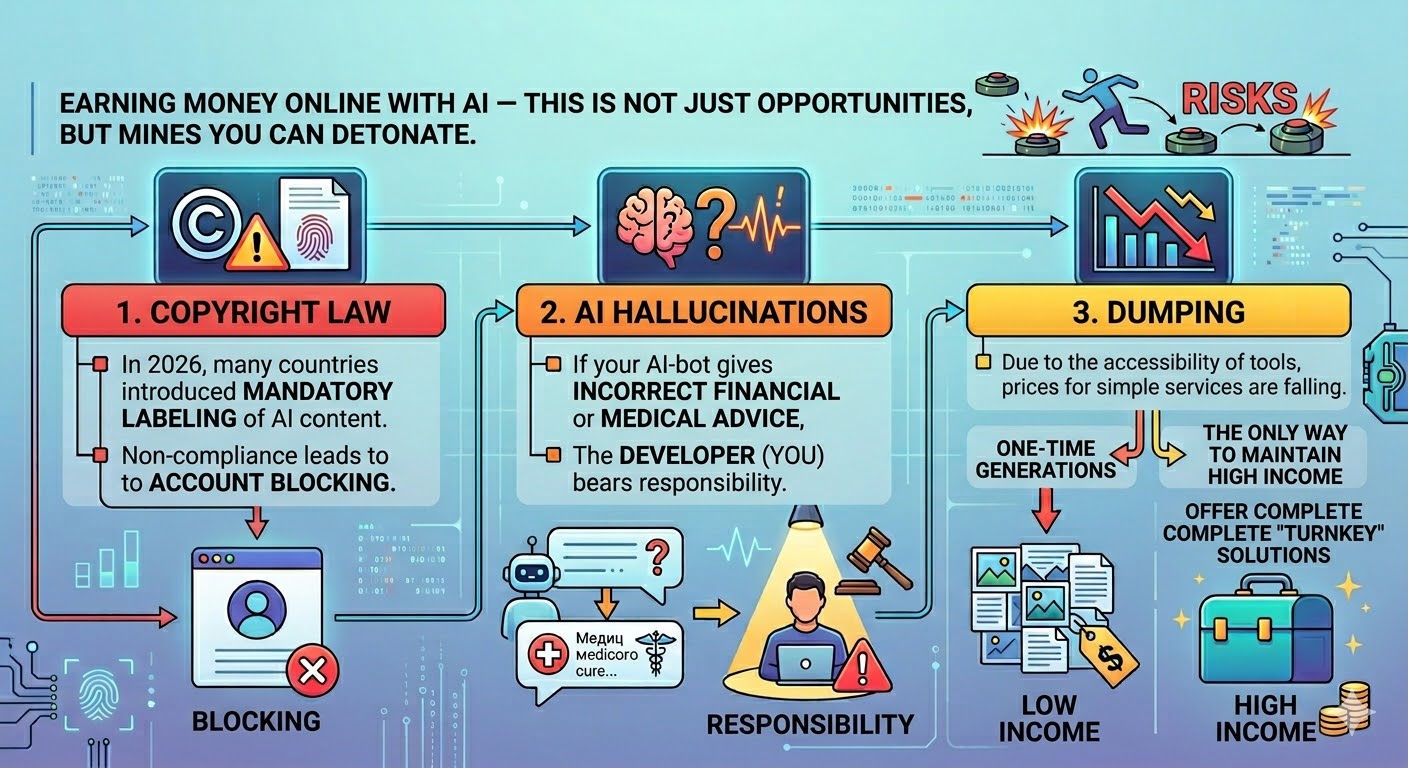
Earning through AI is not just about opportunities; it's also about landmines.
Copyright: In 2026, many countries introduced mandatory labeling for AI content. Failure to comply leads to account bans.
AI Hallucinations: If your AI bot gives incorrect financial or medical advice, the developer (you) bears the responsibility.
Dumping: Due to the accessibility of tools, prices for simple services are falling. The only way to maintain a high income is to offer integrated turnkey solutions, not one-off generations.
Chapter 7. Practical Guide: Where Should a Beginner Start?
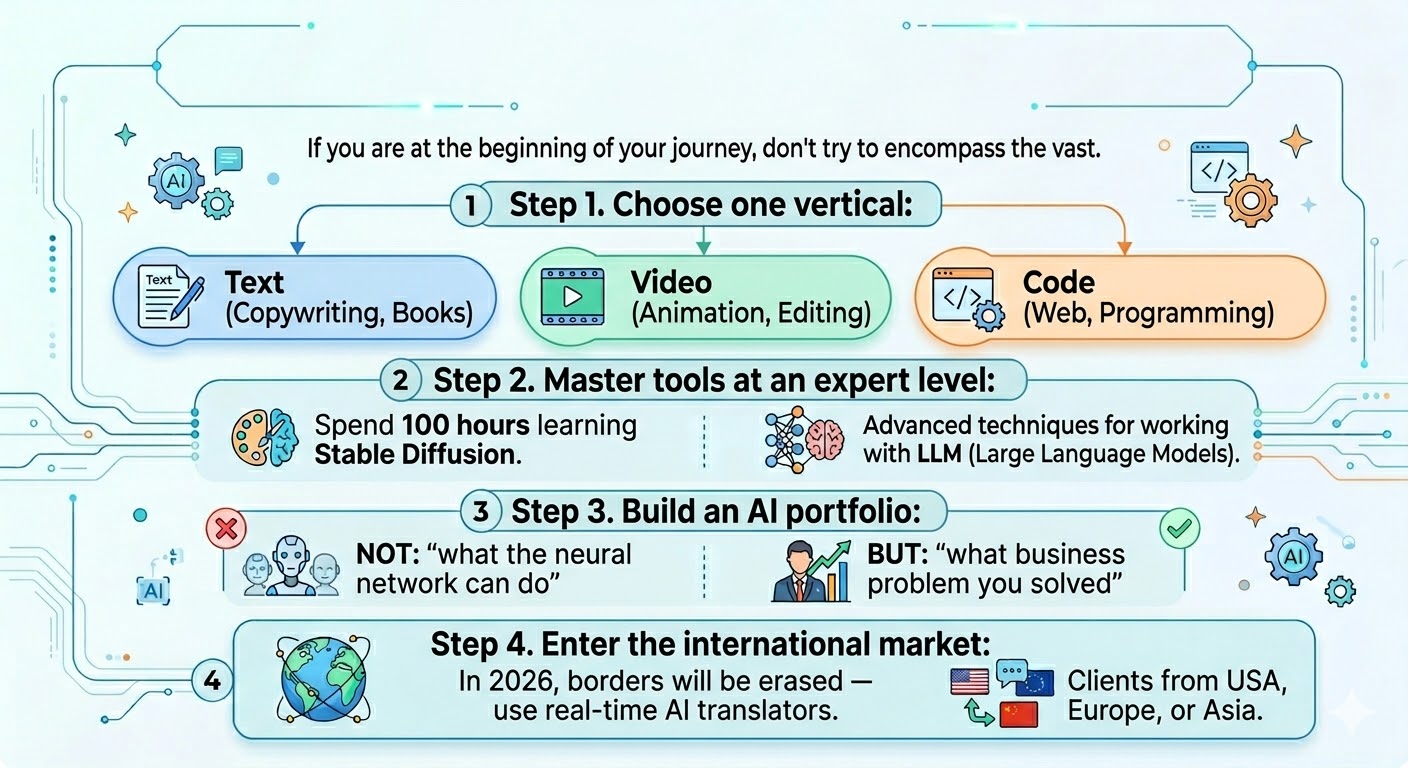
If you are at the beginning of your journey, do not try to embrace everything at once.
Choose one vertical: (Text, Video, or Code).
Master tools at an expert level: Spend 100 hours studying Stable Diffusion or advanced LLM (Large Language Model) techniques.
Build an AI portfolio: It should demonstrate not "what the neural network can do," but "what business problem you solved."
Go international: In 2026, borders are blurred—use real-time AI translators to sell your services to clients in the US, Europe, or Asia.
Conclusion
Online earnings in 2026 are a competition of imagination and technology management skills. Neural networks have given us a superpower: the ability to do the work of an entire agency alone. However, this power requires discipline and constant learning, as AI models update every few months.
We live in a unique time when access to computing power is more important than access to capital. Your workplace is a laptop, your team is a dozen neural networks, and your potential is limited only by your ability to formulate the right questions.







Comments 0