
 EN
 UK
 RU
 AR
 BN
 ZH
 DE
 ES
 FR
 HI
 ID
 UR
 PT
 TR
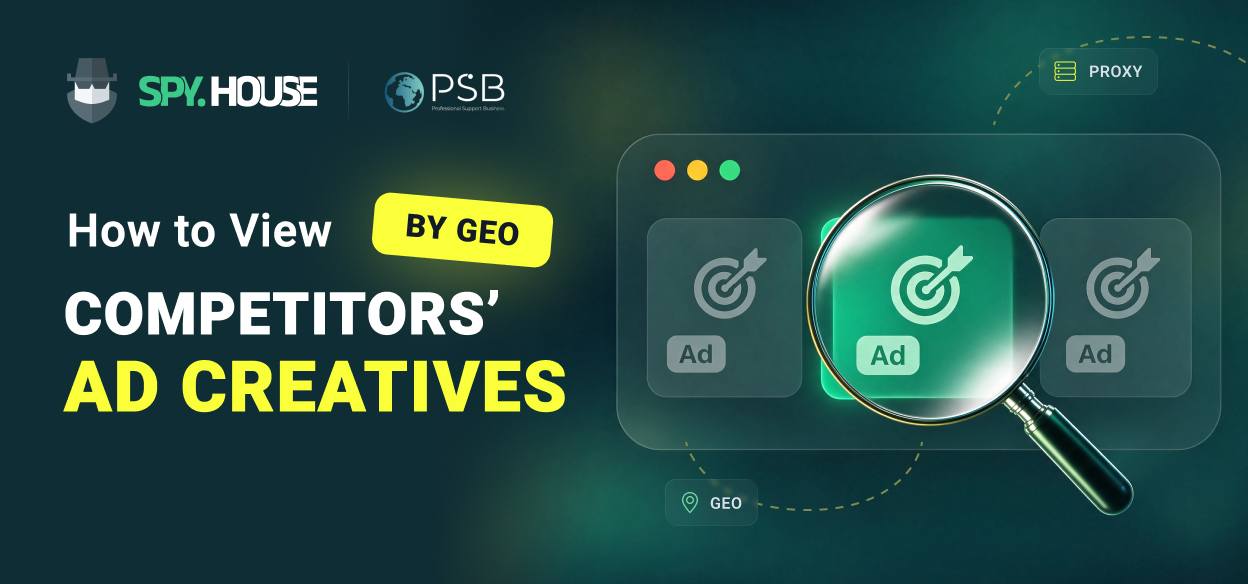
A spy tool shows which creatives, funnels and offers are running on Facebook, TikTok, native, push and in-page networks. But a spy database is what has already been collected. When you need to check a specific ad live - follow it to the landing page and see the pre-lander, price, language and payment methods in the country your competitors target you need an IP from that country. Here is why proxies belong next to your spy tool, which type to choose and how to check creatives by GEO.
Why you see something different from your own country
Ad networks and landing pages adapt to the visitor. What you see depends on:
IP and country. Ads, offers, currency and even whether a page exists depend on GEO.
Connection type. Many funnels target mobile traffic only; from a desktop or server IP you get a placeholder or a different page.
Carrier and city. In some niches the offer is shown only to subscribers of certain carriers or residents of large cities.
Language and time. A browser locale and time zone that do not match the IP also change the picture.
As a result, opening a link from your spy tool from your office can show a “safe” page or nothing at all - and lead to the wrong conclusion about the funnel.
What proxies add to spy work
See the whole funnel - creative, pre-lander, landing page and form - as a user in the target country sees it.
Check whether it is still live. A funnel in the database may have stopped yesterday; an IP from the right GEO shows it immediately.
Compare GEOs. The same offer in Germany, Brazil and India often uses different angles, prices and creatives.
Keep your own IP out of their analytics when you visit competitors’ pages regularly.
Which proxy to choose
Type | When to use | Pros | Cons |
|---|---|---|---|
| Mobile (4G/5G) | Mobile-first funnels: TikTok, push, in-page, apps | Highest trust, real carrier IPs, mobile versions of funnels | Higher price per GB |
| Residential | Facebook, native, desktop funnels, many GEOs | Wide choice of countries and cities, rotating or sticky sessions | Speed depends on the node |
| Datacenter | Bulk link availability checks, monitoring | Fast and cheap | Many landing pages show a placeholder |
A simple rule: view creatives from the same IP type your competitor buys traffic for. Mobile funnel - mobile proxy; desktop funnel - residential. Keep datacenter IPs for technical checks where speed matters more than realism.
A GEO check workflow
Find the funnel in the spy tool. Filter by GEO, source and format; save the creative and link.
Prepare a profile. A separate antidetect browser profile or a clean browser with the locale and time zone of the GEO.
Connect a proxy from that country. Mobile IP (ideally the same carrier) for mobile funnels, residential for desktop.
Use a sticky session so the IP does not change while you go through the funnel.
Go through the funnel and record it: screenshots of every step, price, currency, payment methods, wording, redirects.
Repeat for other GEOs and compare what is localized and what is simply translated.
Come back in a few days. A funnel that lives for a week or more is worth a closer look.
What to look at
Angle of the creative and pre-lander: pain point, benefit, social proof.
Localization: language, currency, local celebrities and brands, payment systems.
Structure: number of steps, where the form is, quizzes or vertical video.
Technical details: load speed, mobile layout, redirect chain.
These observations help you build your own funnel instead of copying someone else’s.
Common mistakes
Checking mobile funnels from a desktop or server IP.
Changing the IP in the middle of a funnel.
Forgetting the browser locale and time zone.
Drawing conclusions from a single visit — some pages show different content at different times.
Where to get proxies for spy work
PSB Proxy offers residential, mobile (4G/5G) and datacenter proxies in 195 countries with country and city targeting, HTTP(S)/SOCKS5, rotating or sticky sessions and pay-per-GB pricing. Funnels are light, so a small traffic package is usually enough for creative research.
Bottom line
A spy tool answers “what are competitors running”, and a proxy answers “how does a user in that country see it”. Together they give the full picture: creative, funnel, prices and localization. Match the IP type to your competitor’s traffic source, keep the IP stable during the check, and your funnel analysis becomes much more accurate.
Frequently Asked Questions
1. Why do you need a proxy when using an ad spy tool?
A proxy allows you to view competitors' ads and follow their links as users in a specific country would. It helps you check whether an ad campaign is still active, access pre-landers and landing pages, and see local prices, currencies, languages, and payment methods.
2. Which type of proxy is best for viewing competitors' creatives?
The choice depends on the competitor's traffic source. Mobile proxies (4G/5G) are best for mobile campaigns from TikTok, push notifications, and in-page ads. Residential proxies are better suited for Facebook, native advertising, and desktop campaigns. Datacenter proxies are mainly useful for bulk technical link checks.
3. Why won't a competitor's landing page open, or why does it display different content?
This may be caused by a mismatch in geolocation, connection type, mobile carrier, browser language, or time zone. For example, if an offer targets mobile users in Brazil, accessing it through a datacenter IP from another country may result in a placeholder page or an alternative version of the landing page.
4. Why is a sticky session important when checking an advertising funnel?
A sticky session keeps the same IP address for a specified period. This is important when navigating from an ad creative to a pre-lander and then to a landing page, as your geolocation remains consistent throughout the process. If your IP changes midway, different funnel stages may display different content.
5. What should you look for when analyzing ad creatives across different GEOs?
Compare advertising angles, copy, visual elements, funnel structure, prices, currencies, and payment methods. Also pay attention to localization, loading speed, mobile layout, and redirect chains. Rechecking the funnel after a few days will help you determine how long the campaign remains active.




Comments 0