
 EN
 UK
 RU
 AR
 BN
 ZH
 DE
 ES
 FR
 HI
 ID
 UR
 PT
 TR
In traffic arbitrage, proxies are part of the working infrastructure. The IP address type, geolocation, and connection stability affect how reliably you can check ads, access landing pages, and use analytics tools.
Most often, the choice comes down to mobile and residential proxies. Both use IP addresses associated with user networks, but they differ in their connection sources, session characteristics, and use cases.
Let’s look at how mobile proxies differ from residential ones, when to choose each option, and how to test a connection before launching an ad campaign.
Mobile vs. Residential Proxies: What’s the Difference?
The main difference lies in the network to which the IP address belongs.
Mobile proxies use IP addresses provided by mobile carriers. The connection runs through a mobile network, such as 4G or 5G. Depending on the provider’s infrastructure, the IP address may change when reconnecting or according to a configured rotation rule.
Residential proxies use IP addresses associated with home and other user networks provided by ISPs. They let you access websites from different geographic regions and, with rotating solutions, change the exit IP according to the service settings.
There is no universal winner. A mobile IP does not guarantee that you will avoid checks, and a residential IP is not necessarily less stable or lower quality. The result depends on the specific IP address, platform, and type of activity.
When Are Mobile Proxies Suitable for Traffic Arbitrage?
Mobile proxies are worth considering when your workflow specifically requires a connection through a cellular network.
For example, they can be useful in the following situations:
Testing a mobile advertising funnel. You need to make sure a landing page opens correctly over a mobile network and that transitions and redirects work as expected.
Testing location-dependent ads. You want to check how ads and landing pages appear in a particular country or through a specific carrier’s network.
Working with mobile services. If your task involves testing features designed for smartphone users, a mobile IP may better match the testing conditions.
Scenarios where network type matters. Sometimes choosing a country is not enough: you need to check whether a service is accessible specifically through a mobile carrier’s infrastructure.
However, buying mobile proxies simply because they are considered more suitable for traffic arbitrage is not always a rational choice. If your main goal is to check ads, analyze localized pages, and compare offers across regions, a residential proxy pool may be sufficient.
The technical side also matters: mobile connections do not always provide consistent speeds, and changing IP addresses can affect long-running sessions. Before scaling up, test proxies against the actions you actually need to perform.
When Should You Choose Residential Proxies?
Residential proxies are suitable for a wide range of tasks involving websites and region-specific content. They are particularly useful for checking ads, landing pages, and funnel performance across different GEOs.
The main use cases include:
1. Checking landing pages and redirects. You can open a target page through a proxy with the required geolocation and check where a link leads, what content is displayed, and whether the redirect works correctly.
2. Checking ads by region. If a page’s content depends on location, a residential IP can help you check how the website appears from a selected country. However, IP geolocation is not the only factor: cookies, account settings, language, and the region specified on the platform can also affect the result.
3. Monitoring advertising offers. When working across multiple markets, it is important to compare terms, prices, page content, and offer availability. Residential proxies make it possible to organize these checks for the required locations.
4. Collecting public data and conducting analytics. They can be used to study competitors’ pages, check search results, and regularly monitor publicly available information, subject to the platform’s rules and acceptable request rates.
5. Checking advertising materials before launch. A proxy lets you check whether a landing page is accessible from the target region, whether connection errors occur, and whether the actual result matches your expectations.
For these tasks, the IP type is not the only consideration. Access to the required countries, rotation rules, connection quality, and traffic usage controls are also important.
Where to Get Residential Proxies for Testing
Residential proxies are available from Node Proxy. The service lets you choose a GEO and use a pool of residential IPs to access websites and check how content is displayed in different regions. Depending on your needs, you can configure IP rotation by time or request, or use Sticky mode to keep the same IP throughout a session.
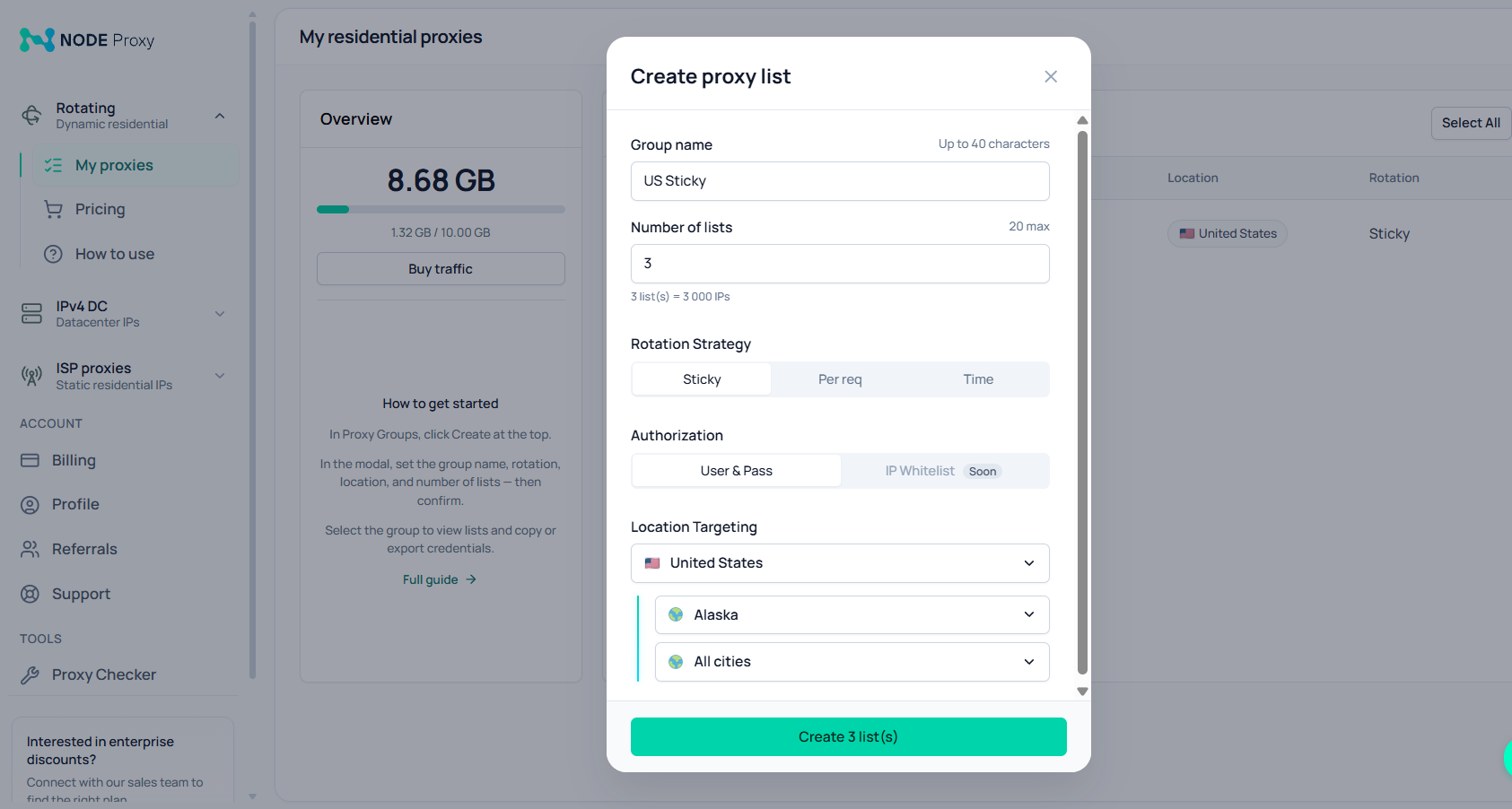
Before purchasing a large amount of traffic, it is better to start with a small test: check the connection, open the required pages, and measure actual traffic usage. This will help you determine whether the selected option suits your workflow.
How to Check a Proxy Before Launch
Even if a proxy type is suitable for your needs, you should test it before use. An incorrect port or authentication setting can look like a problem with the advertising platform, even when the connection itself is not working.
Follow these steps to check your connection:
Make sure the proxy is accessible. Check that the address, port, username, and password are correct.
Check the exit IP. It should correspond to the proxy connection rather than your regular internet connection.
Verify the geolocation. The country and, if relevant to your task, the city should match the selected GEO. Different geolocation databases may return slightly different results.
Test your actual use case. Open the target landing page, check redirects, and make sure pages load without errors.
Evaluate stability. Repeat the test several times to distinguish an isolated failure from a recurring issue.
For diagnostics, you can use the free Node Proxy proxy checker. It allows you to check whether proxies are working.
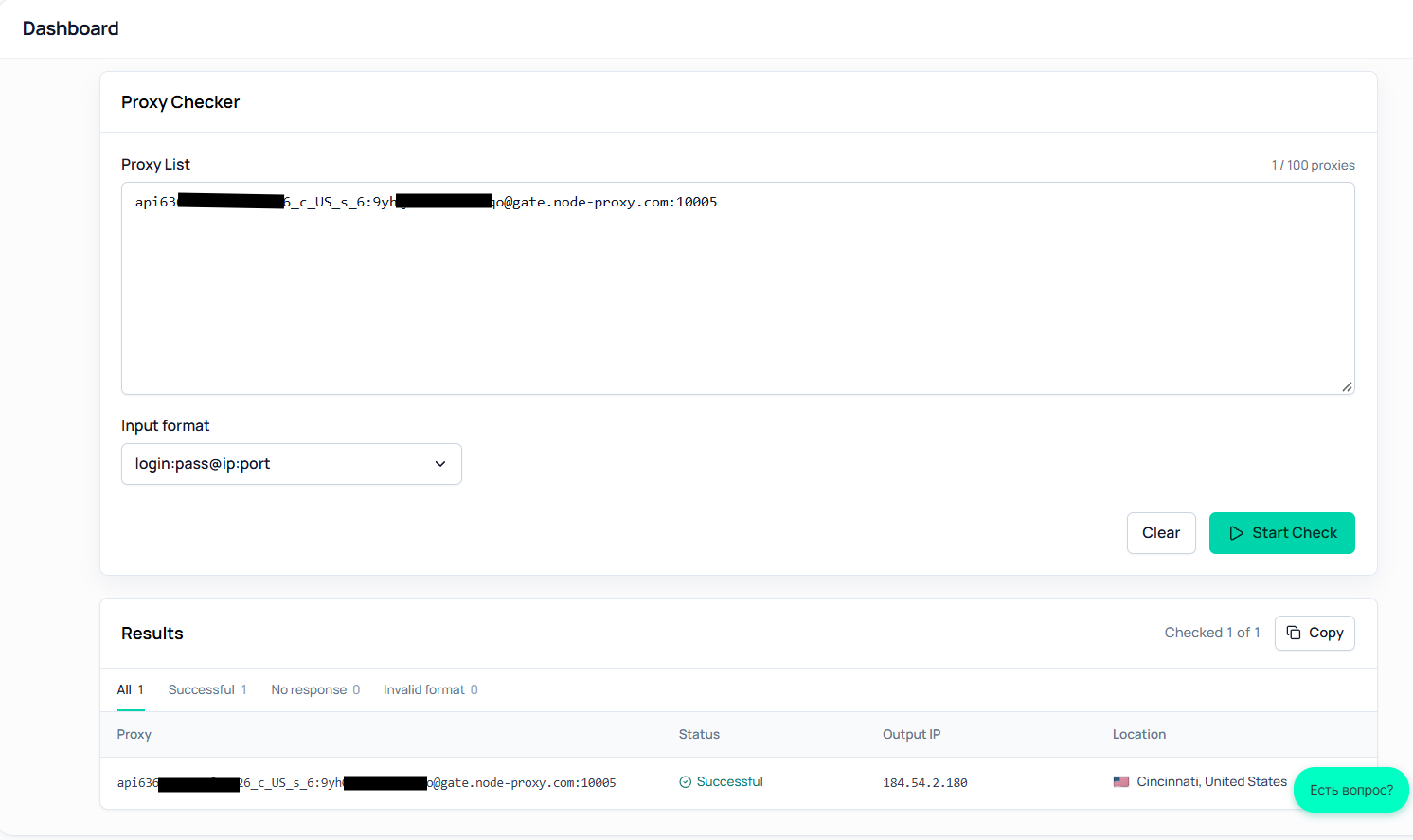
Keep in mind that a checker can help identify network issues, but it does not evaluate your entire browser configuration, account status, or whether your advertising campaign complies with platform rules.
IP Rotation and Session Stability
When choosing a proxy, the IP’s origin is not the only thing that matters. You should also consider how long the address remains in use.
Rotation means changing the exit IP according to a specified rule. Depending on the service, the address may change over time, with each request, or when a new session starts. This can be useful for repeated checks and working with large numbers of pages.
However, changing the IP with every action is not always necessary. If a test involves several consecutive steps, frequent address changes can interrupt session continuity or make troubleshooting more difficult. In such cases, a mode that preserves the IP for the required period may be more useful.
Do not treat rotation as a substitute for properly configuring your advertising workflow. It does not guarantee that you will avoid restrictions or remove platform requirements for accounts, ads, and user activity.
Common Mistakes When Choosing Proxies
Choosing a type based only on its reputation. The claim that mobile proxies are always better than residential ones is too broad. You should compare them on the specific platform and for the task at hand.
Focusing only on the country. An IP from the required GEO does not guarantee that a website will display the expected content. Account region settings, language, and cookies can also affect the result.
Ignoring speed and stability. Even a correctly configured IP can be unsuitable for your workflow if the connection frequently drops or pages take too long to load.
Buying a large amount without testing. Test several scenarios first and measure actual traffic consumption. This will help you estimate costs more accurately.
Treating the proxy as the only factor. Advertising infrastructure also depends on browser settings, cookies, landing page quality, account status, campaign settings, and the platform’s rules.
Conclusion: Which Proxy Type Should You Choose for Traffic Arbitrage?
Mobile proxies are a logical choice when connecting through a cellular network is essential. Residential proxies are useful when you need to check websites, analyze region-specific content, test landing pages, and monitor results across different GEOs.
If your requirements are not yet clear, you do not have to choose a single type for every workflow. Start with a small test and compare connection success rates, speed, stability, and traffic usage. Different stages of your work may benefit from different solutions.
The main criterion is not the proxy type itself, but how well it performs the specific task at an acceptable cost. Testing before scaling up helps avoid unnecessary expenses and lets you choose infrastructure based on measurable results.






Comments 0