
 EN
EN
 UK
UK
 RU
RU
 AR
AR
 BN
BN
 ZH
ZH
 DE
DE
 ES
ES
 FR
FR
 HI
HI
 ID
ID
 UR
UR
 PT
PT
 TR
TR

The internet has never been more accessible—or more protected.
Businesses rely on web data for market research, price monitoring, SEO analysis, ad verification, AI training, and competitive intelligence. At the same time, websites are investing heavily in anti-bot technologies designed to detect and limit automated traffic.
This has created a common challenge for developers, marketers, and data teams: how do you access publicly available information at scale without constantly running into blocks, CAPTCHAs, and rate limits?
For years, proxies were considered the primary solution. However, in 2026, simply adding a proxy to your scraper or automation tool is no longer enough. Modern anti-bot systems analyze far more than IP addresses, forcing businesses to rethink how they approach web scraping and browser automation.
In this guide, we'll explore how anti-bot systems work, why some proxy strategies fail, and what businesses are doing today to collect data more reliably.
Why Websites Are Harder to Access in 2026
A decade ago, many websites relied on basic rate limiting. If an IP address sent too many requests, it was blocked.
Today, the situation is very different.
Large platforms now use advanced anti-bot solutions capable of analyzing dozens of signals simultaneously. Their goal is not just to identify suspicious IP addresses but to determine whether traffic behaves like a real user.
Common detection signals include:
- Request frequency
- Session duration
- Browser fingerprints
- Device characteristics
- Cookie consistency
- Geographic patterns
- Navigation behavior
- TLS fingerprints
- Historical IP reputation
As a result, businesses often discover that even when they use proxies, their requests still encounter verification challenges.
The reason is simple: modern anti-bot systems evaluate entire behavior patterns rather than relying on a single signal.
Understanding How Anti-Bot Systems Detect Automation
Many users assume websites only care about where traffic comes from.
In reality, websites care just as much about how traffic behaves.
Imagine two visitors arriving from the same city.
The first visitor:
Browses several pages
Spends time reading content
Clicks naturally between sections
Maintains a consistent session
The second visitor:
Requests 200 pages within seconds
Never loads images
Uses identical timing intervals
Shows no human browsing behavior
Even if both visitors use residential IPs, the second visitor is far more likely to be flagged.
Modern anti-bot systems are increasingly focused on identifying these behavioral anomalies.
This explains why some scraping projects fail despite using large proxy pools.
Why Datacenter Proxies Often Struggle
Datacenter proxies remain popular because they offer:
High speed
Low latency
Affordable pricing
Predictable performance
For many applications, these benefits are valuable.
However, datacenter IP addresses originate from hosting providers rather than internet service providers (ISPs). This makes them easier for websites to classify as non-residential traffic.
When accessing highly protected platforms, datacenter proxies often face:
Increased CAPTCHA frequency
More aggressive rate limiting
Lower success rates
Faster IP reputation degradation
This doesn't mean datacenter proxies are obsolete. They continue to perform well for many low-risk tasks.
The challenge appears when users attempt to access websites that invest heavily in bot detection.
Why Residential Proxies Continue to Play a Major Role
Residential proxies route traffic through IP addresses assigned by internet service providers to real devices.
Because these IPs resemble normal user traffic, they often experience fewer trust issues than traditional datacenter infrastructure.
This makes residential proxies particularly useful for:
Web scraping
Search engine monitoring
Ad verification
Market research
Brand protection
E-commerce intelligence
Browser automation
The advantage is not invisibility.
The advantage is authenticity.
When combined with realistic browsing behavior, residential proxies help create traffic patterns that more closely resemble genuine user activity.
This is one reason why residential proxies remain a preferred solution for businesses that depend on large-scale data collection.
The Most Common Mistakes That Trigger Blocks
Many automation failures result from configuration issues rather than poor proxy quality.
Let's examine several mistakes that frequently increase detection rates.
Rotating IPs Too Aggressively
Some users rotate IPs after every request.
While rotation is useful, excessive rotation can appear suspicious.
If a website sees the same session moving between multiple countries within minutes, trust decreases rapidly.
Instead, businesses should select rotation strategies based on the task:
Sticky sessions for account-based activities
Controlled rotation for scraping
Dynamic rotation for large-scale data collection
Ignoring Geographic Consistency
Location signals matter.
A user appearing to browse from Germany while using a U.S. time zone and Japanese browser settings creates inconsistencies that anti-bot systems can detect.
Maintaining alignment between:
IP location
Browser language
Device settings
Time zone
often improves reliability.
Sending Requests Too Quickly
Even high-quality residential proxies cannot fully compensate for unrealistic traffic behavior.
Warning signs include:
Hundreds of requests per minute
Perfect request intervals
Repetitive navigation patterns
Human browsing behavior is naturally inconsistent.
Automation should reflect that reality whenever possible.
Neglecting Browser Fingerprints
Many websites evaluate far more than IP addresses.
They may analyze:
Screen resolution
Installed fonts
Operating system
Browser version
Hardware characteristics
A legitimate residential IP combined with an obviously automated browser can still trigger verification systems.
Successful automation projects often combine residential proxies with proper browser fingerprint management.
Building a Reliable Data Collection Workflow
The most successful data teams view proxies as one component of a larger system.
Instead of relying entirely on IP rotation, they focus on multiple areas simultaneously.
Session Management
Sessions should behave logically.
Users typically browse multiple pages during a visit rather than making isolated requests.
Maintaining session continuity often improves trust signals.
Traffic Distribution
Request volume should be distributed naturally.
Gradual scaling generally produces better results than sudden traffic spikes.
Performance Monitoring
Key metrics include:
Success rate
Response time
CAPTCHA frequency
Block rate
Session duration
Monitoring these metrics helps identify problems before they affect project outcomes.
Adaptive Strategies
Different websites require different approaches.
A configuration that works perfectly for an e-commerce site may perform poorly on a search engine or social platform.
Continuous testing and optimization remain essential.
How Businesses Use Residential Proxies Today
Residential proxies are no longer used exclusively by scraping specialists.
Organizations across multiple industries rely on them for legitimate operational purposes.
E-Commerce Intelligence
Retailers monitor:
Product pricing
Inventory changes
Competitor promotions
across multiple regions.
SEO and Search Monitoring
Marketing teams analyze:
Search rankings
Localized results
SERP variations
without being influenced by their own location.
Ad Verification
Brands verify whether advertisements appear correctly in different countries and regions.
Market Research
Analysts gather publicly available information to understand:
Industry trends
Consumer behavior
Competitive landscapes
As data-driven decision making becomes increasingly important, demand for reliable residential proxy infrastructure continues to grow.
Choosing the Right Residential Proxy Provider
Not all residential proxy networks are the same.
When evaluating providers, businesses should consider several factors beyond price alone.
IP Pool Size
A larger IP pool helps distribute traffic more effectively and reduces repetition.
Geographic Coverage
Global businesses often require access to multiple countries and regions.
Session Control
Different projects require different rotation strategies.
Support for both rotating and sticky sessions provides greater flexibility.
Network Stability
Consistent uptime and reliable performance are essential for long-term projects.
Integration Simplicity
Developers benefit from straightforward integration with scraping tools, browser automation frameworks, and custom applications.
Selecting a provider based on these criteria often delivers better long-term results than focusing exclusively on cost.
How Swiftproxy Supports Modern Data Collection
As anti-bot systems become more sophisticated, businesses need proxy infrastructure that adapts to changing requirements.
Swiftproxy provides access to over 80 million residential IPs across 195+ locations worldwide, helping organizations build geographically targeted data collection workflows while maintaining flexibility.
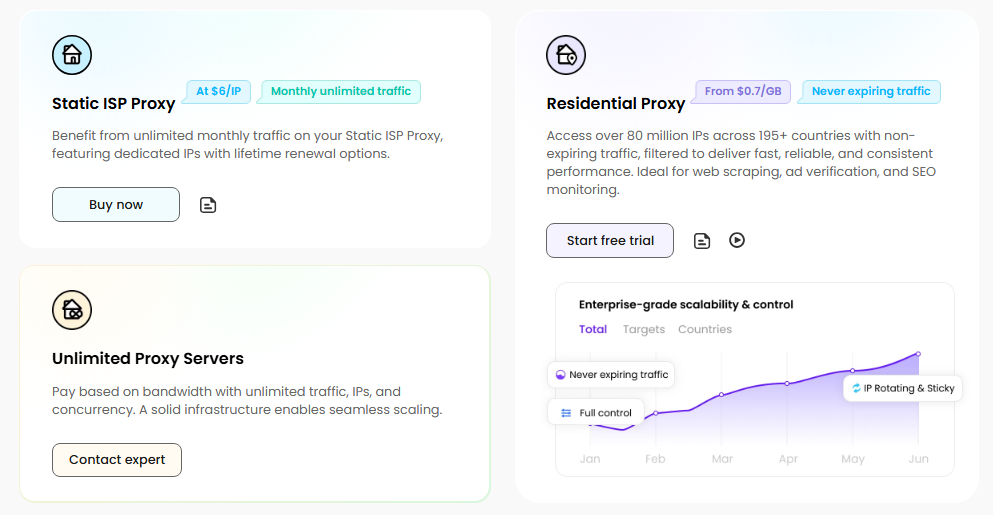
Features commonly used by scraping and automation teams include:
Large residential IP pool
Rotating residential proxies
Sticky session support
Country-level targeting
High concurrency support
Easy integration with automation tools
Rather than relying on a one-size-fits-all approach, users can tailor proxy behavior to match specific project requirements.
Whether the goal is market research, search monitoring, browser automation, or large-scale web scraping, having access to reliable residential infrastructure helps reduce operational friction and improve consistency.
The Future of Web Scraping and Automation
The relationship between proxies and anti-bot systems will continue to evolve.
As websites become more sophisticated, successful data collection will depend less on finding ways to avoid detection and more on creating realistic, trustworthy traffic patterns.
Residential proxies remain an important part of that process, but they are only one piece of the puzzle.
Businesses that combine:
High-quality residential proxies
Intelligent session management
Geographic consistency
Browser fingerprint control
Responsible request pacing
They are far more likely to achieve sustainable results. In 2026, the question is no longer whether proxies work. The real question is whether your entire workflow is designed to look and behave like genuine user activity.
When the answer is yes, blocks become less frequent, data quality improves, and automation becomes significantly more reliable.






Comments 0