
 EN
 UK
 RU
 AR
 BN
 ZH
 DE
 ES
 FR
 HI
 ID
 UR
 PT
 TR
In traffic arbitrage, the success of an advertising campaign largely depends on the quality of preliminary research. Before launching a campaign, it is important to understand which creatives competitors are using, which offers advertisers are promoting, which GEOs they are targeting, and which advertising approaches are already delivering results. Spy tools are designed to address these needs - they are platforms for monitoring and analyzing advertising campaigns.
Among the solutions worth considering for media buyers and traffic arbitrage specialists are Spy.House and AdPlexity. Both services help users research competitors' advertising campaigns, find creative ideas, and analyze the market. However, they differ in their business models, advertising source coverage, and subscription costs.
Let's take a closer look at which spy tool offers more value for money and why Spy.House could be a more cost-effective solution for traffic arbitrage specialists in 2027.
1. Overview of the Services
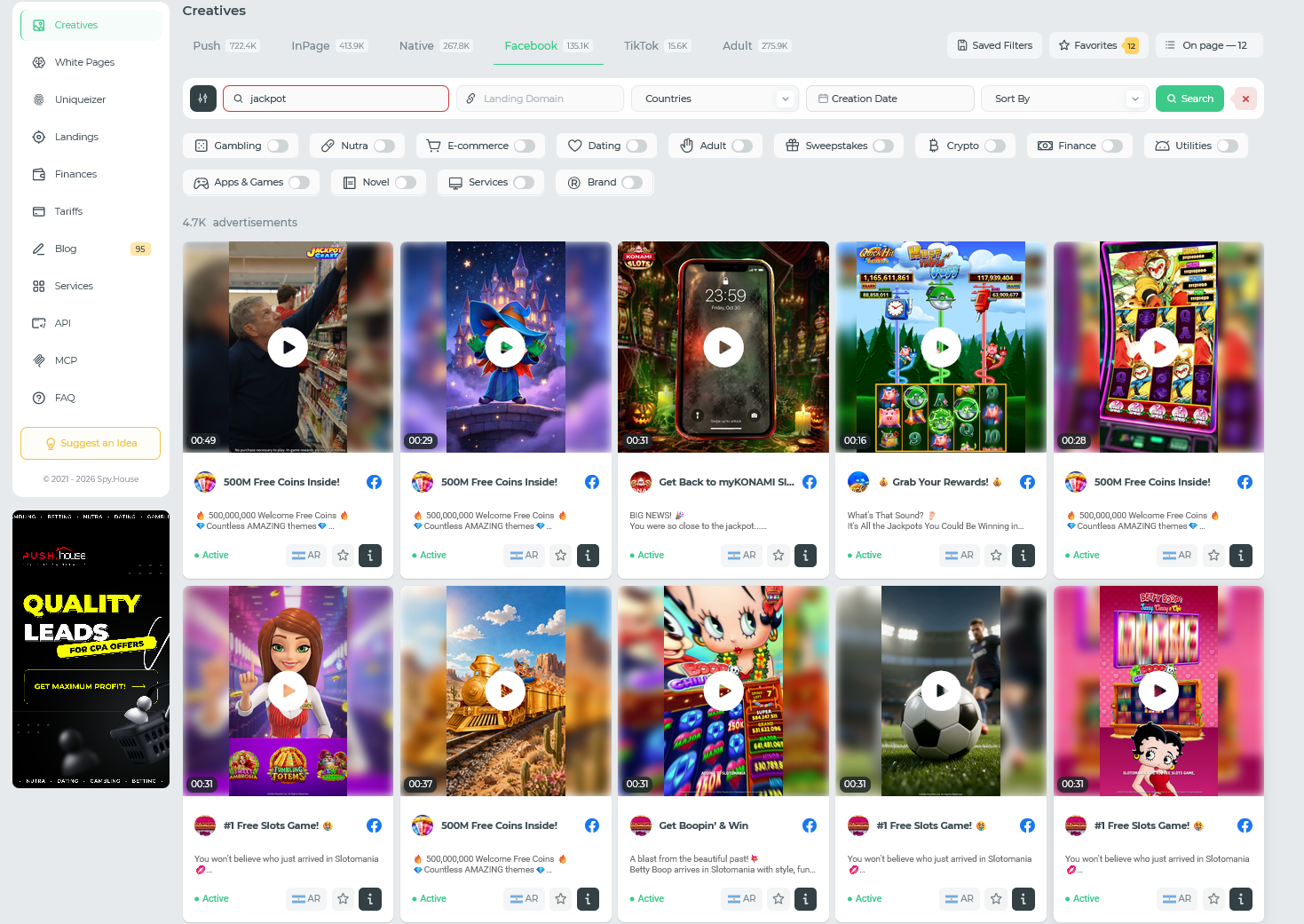
Spy.House is a multifunctional platform for finding, monitoring, and analyzing advertising creatives. It covers several popular traffic sources at once: Push, In-Page, Native, Facebook, TikTok, and Adult.
The platform's main advantage is that it brings different advertising formats together in a single interface. Users do not need to purchase separate subscriptions to research each advertising vertical. They can switch between traffic sources and apply filters based on GEO, devices, languages, ad networks, and other parameters.
Another advantage of Spy.House is its set of tools for working with advertising materials. These include landing page downloads, AI-powered White Page generation, Creative Uniqueizer, API access, and integration with AI assistants through MCP.
AdPlexity is a well-known competitive intelligence tool designed for professional media buyers, affiliate teams, and advertising agencies. Its ecosystem includes separate products for Social, Native, Push, Desktop, Mobile, and Adult.
The service provides extensive advertising databases, ad search capabilities, landing page analysis, tracking of advertising strategies, and tools for grouping similar creatives.
The main difference lies in the access model: AdPlexity sells separate subscriptions for different traffic sources, whereas Spy.House provides access to multiple formats under a single subscription.
2. Comparison of Advertising Sources
One of the main criteria when choosing a spy tool is the number of available advertising platforms and formats. The broader the coverage, the more opportunities there are to discover promising campaigns.
Spy.House supports six main categories:
Push advertising;
In-Page;
Native;
Facebook;
TikTok;
Adult.
This selection allows users to research different verticals and advertising strategies using a single platform. For example, a traffic arbitrage specialist can study Push campaigns in Nutra, analyze Facebook creatives in Dating, and simultaneously explore approaches in Adult traffic.
AdPlexity also offers six standalone products: Social, Native, Push, Desktop, Mobile, and Adult. The platform covers more than 30 advertising networks and traffic sources.
AdPlexity's strength lies in its extensive specialized databases. The service is particularly interesting for researching Native advertising, mobile traffic, and Desktop formats.
However, there is one important consideration: accessing multiple categories requires purchasing several separate products.
Spy.House advantage: users can work with six advertising formats under a single subscription. This is especially convenient for traffic arbitrage specialists who test different traffic sources and do not want to limit themselves to a single advertising platform.
3. Features and Functionality
Both services provide tools for analyzing competitors' advertising campaigns, but their additional features differ.
What Spy.House Offers
In addition to ad search, the platform provides the following capabilities:
Advanced Filters. Users can filter ads by GEO, traffic source, device, language, browser, operating system, and other parameters. This makes it easier to find advertising campaigns that match specific requirements.
Landing Page Downloads. Users can download competitors' landing pages to examine their structure, content, and marketing strategies.
AI White Page Generator. This tool allows users to create White Pages using artificial intelligence based on a text description.
Creative Uniqueizer. This feature helps generate new versions of advertising images and videos. It is useful when preparing original creatives and testing different visual concepts.
API. The API makes it possible to integrate the service's data into custom tools and automate certain research processes.
MCP Integration. Spy.House supports connections to AI clients, including ChatGPT, Claude, and other compatible solutions. This opens up additional opportunities for automating research.
What AdPlexity Offers
AdPlexity's functionality is primarily focused on in-depth advertising campaign analytics.
Its features include:
Searching for ads by keywords, URLs, and other parameters;
Analyzing advertising creatives and their variations;
Saving ads and landing pages to Boards;
Investigating redirect chains;
Analyzing domains, offers, and landing pages;
Daily reports with CSV export capabilities;
Grouping similar advertising materials.
AdPlexity is particularly useful for specialists who need to investigate advertising funnels and track relationships between ads, domains, and landing pages.
Nevertheless, in terms of the number of additional tools, Spy.House appears to be a more versatile solution. In particular, AI-powered White Page generation, Creative Uniqueizer, and MCP expand its capabilities beyond conventional ad search.
4. Subscription Pricing Comparison
Price is one of the most important factors when choosing a spy tool. This is especially true for beginner traffic arbitrage specialists and small teams that need to keep their infrastructure costs under control.
Spy.House Pricing Plans
The official website offers four subscription options:
Starter - $29 per month;
Basic - $59 per month;
Premium - $99 per month;
Enterprise - $199 per month.
The plans differ in the number of search queries and Creative Uniqueizer limits.
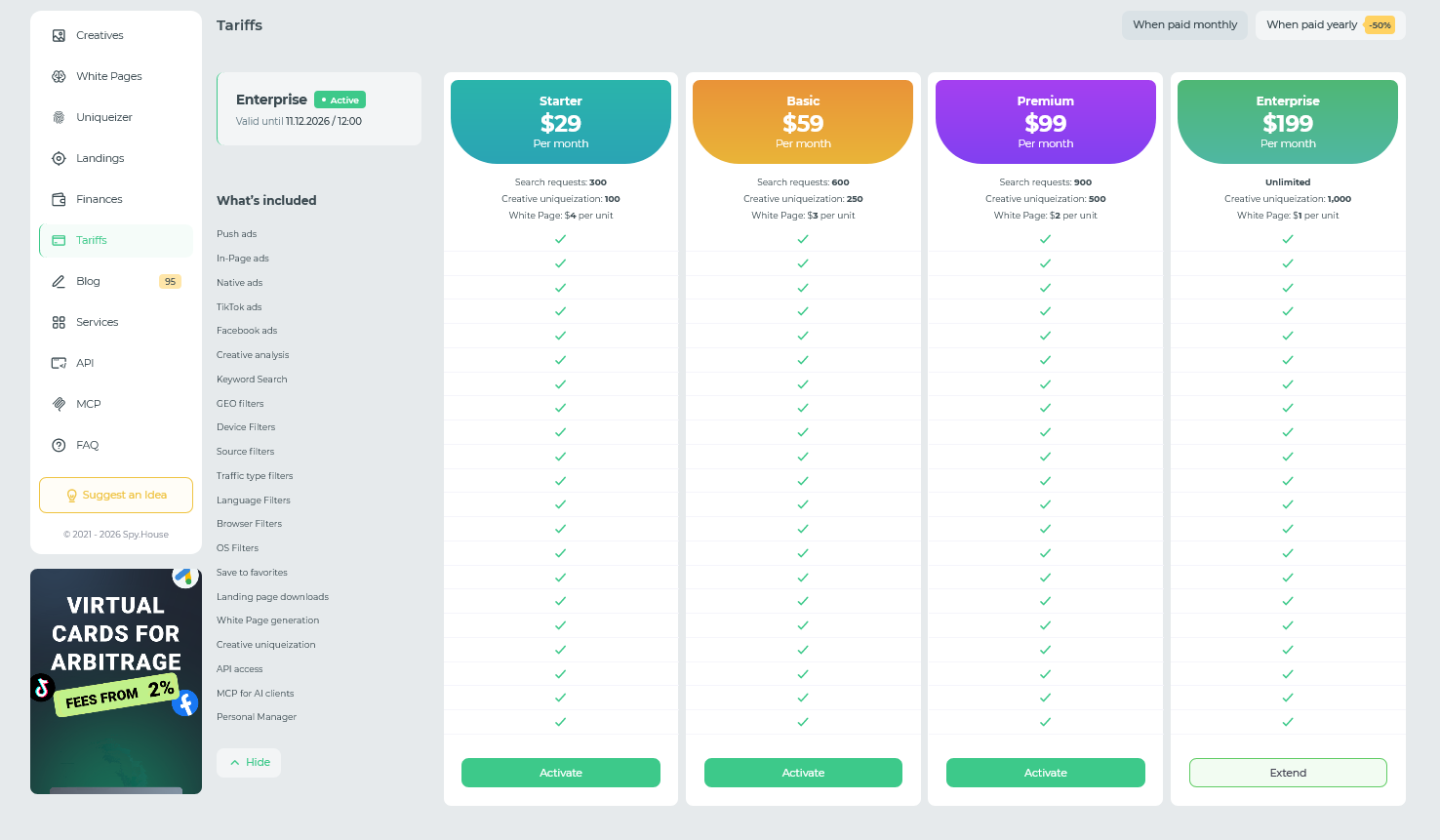
Starter includes 300 search queries and 100 creative uniqueization operations. Basic increases these limits to 600 queries and 250 creatives. Premium offers 900 queries and 500 creatives. Enterprise removes the limit on the number of search queries.
Additional discounts are available for annual subscriptions.
An important point: all plans provide access to the platform's main advertising formats. This means that even an entry-level subscription gives users access to several traffic sources.
AdPlexity Pricing Plans
AdPlexity uses a different pricing model. Each product must be purchased separately.
Current monthly prices:
Social - $99;
Native - $249;
Push - $149;
Desktop - $199;
Mobile - $199;
Adult - $199.
Annual subscriptions offer discounts of approximately 20%.
For example, if a specialist needs Push, Native, and Social simultaneously, the monthly cost will be $497. Even then, the user only gets access to three categories.
For comparison: Spy.House Starter costs $29 per month and already includes Push, In-Page, Native, Facebook, TikTok, and Adult.
The price difference becomes particularly noticeable for specialists working with multiple advertising sources simultaneously.
As a result, Spy.House offers better value for money in terms of pricing and the number of available formats. AdPlexity may be worth the investment when highly specialized analytics are required, but using it for comprehensive advertising research is considerably more expensive.
5. Ease of Use and Research Speed
When working with large volumes of advertising data, functionality is not the only important factor. The convenience of the search process also matters.
Spy.House offers a filtering system that allows users to quickly narrow down search results based on specific parameters. This helps reduce the time spent searching for relevant ads and allows specialists to focus directly on analyzing advertising strategies.
Additional tools also make it possible to complete several tasks within a single platform: finding creatives, researching landing pages, creating White Pages, and preparing new versions of advertising materials.
AdPlexity focuses on in-depth, structured analytics. Its ad grouping, redirect analysis, and domain and offer research tools are particularly useful.
Both solutions are suitable for professional use. However, Spy.House offers a more streamlined infrastructure for specialists who work with multiple traffic sources.
6. Which Service Should You Choose in 2027?
The right choice depends on the specifics of your advertising campaigns and your budget.
Spy.House is better suited for:
Beginner traffic arbitrage specialists looking for an affordable advertising research tool;
Media buyers working with multiple traffic sources;
Affiliate teams testing different verticals;
Specialists who need tools for working with advertising creatives;
Teams interested in automating analytics through API and AI integrations.
AdPlexity is worth considering for:
Professional media buyers with a dedicated analytics budget;
Native advertising specialists;
Teams that require detailed advertising funnel analysis;
Agencies managing large numbers of advertising campaigns and domains.
Overall, AdPlexity remains a powerful specialized tool, particularly in certain advertising categories. However, Spy.House offers a more versatile approach.
7. Final Comparison: Spy.House or AdPlexity?
Both services address the same fundamental need: helping users analyze competitors' advertising campaigns and discover promising advertising strategies. However, their strengths differ across several key areas.
Spy.House stands out in terms of affordability, the combination of advertising formats, and additional tools. AdPlexity is notable for its in-depth specialized analytics and dedicated databases.
A comparison of the two solutions across the main criteria gives us the following picture:
Traffic source coverage: Spy.House combines six formats under one subscription, while AdPlexity offers six separate products.
Entry-level pricing: Spy.House starts at $29 per month; AdPlexity starts at $99 for Social, $149 for Push, or $249 for Native.
Landing page analysis: Both services support downloading and researching landing pages.
Creative management: Spy.House additionally offers Creative Uniqueizer.
AI tools: Spy.House includes a White Page generator and MCP integration.
In-depth funnel analytics: AdPlexity provides advanced tools for analyzing redirects, domains, and offers.
Conclusion
When evaluating spy tools in terms of versatility, pricing, and the number of available features, Spy.House appears to be the more cost-effective choice for most traffic arbitrage specialists in 2027.
Its main advantage is the ability to research multiple advertising sources without purchasing separate subscriptions. Even the entry-level $29 monthly plan provides access to the main advertising formats, while additional features help users not only analyze competitors but also work on their own advertising materials.
AdPlexity is worth considering when specialized analytics for a particular advertising category are required. However, if comprehensive market research is the goal, the cost of maintaining multiple subscriptions can become substantial.
As a result, Spy.House can be recommended as a more affordable and versatile solution for everyday traffic arbitrage activities. It helps reduce analytics tool expenses, combine research across different advertising channels, and gain additional capabilities for preparing advertising campaigns.
For specialists who want to use their budgets efficiently without limiting themselves to a single traffic source, Spy.House becomes a particularly attractive alternative to AdPlexity.
Frequently Asked Questions
1. How is Spy.House different from AdPlexity?
The main difference lies in their access models and feature sets. Spy.House combines six advertising formats under one subscription, while AdPlexity offers separate products for each traffic source. In addition, Spy.House provides extra tools, including AI White Page Generator, Creative Uniqueizer, API, and MCP integration.
2. How much do Spy.House and AdPlexity subscriptions cost?
Spy.House pricing starts at $29 per month for the Starter plan. AdPlexity pricing starts at $99 for Social, $149 for Push, and $249 for Native. However, working with multiple advertising sources on AdPlexity requires purchasing separate subscriptions.
3. Which advertising sources does Spy.House support?
Spy.House allows users to analyze six categories: Push, In-Page, Native, Facebook, TikTok, and Adult. This enables traffic arbitrage specialists to research different verticals and advertising strategies within a single platform.
4. Which spy tool is better for beginner traffic arbitrage specialists?
Spy.House is the more affordable option, thanks to its $29 monthly entry-level subscription and access to multiple advertising formats. This allows beginners to research competitors, find creative ideas, and analyze the advertising market without spending heavily on tools.
5. When should you choose AdPlexity over Spy.House?
AdPlexity is worth considering when in-depth analytics of specific advertising categories are the priority. The service offers tools for investigating redirects, domains, offers, advertising funnels, and groups of similar ads. It can be particularly useful for professional media buyers and agencies with a dedicated competitive intelligence budget.




Comments 0