
 EN
EN
 UK
UK
 RU
RU
 AR
AR
 BN
BN
 ZH
ZH
 DE
DE
 ES
ES
 FR
FR
 HI
HI
 ID
ID
 UR
UR
 PT
PT
 TR
TR
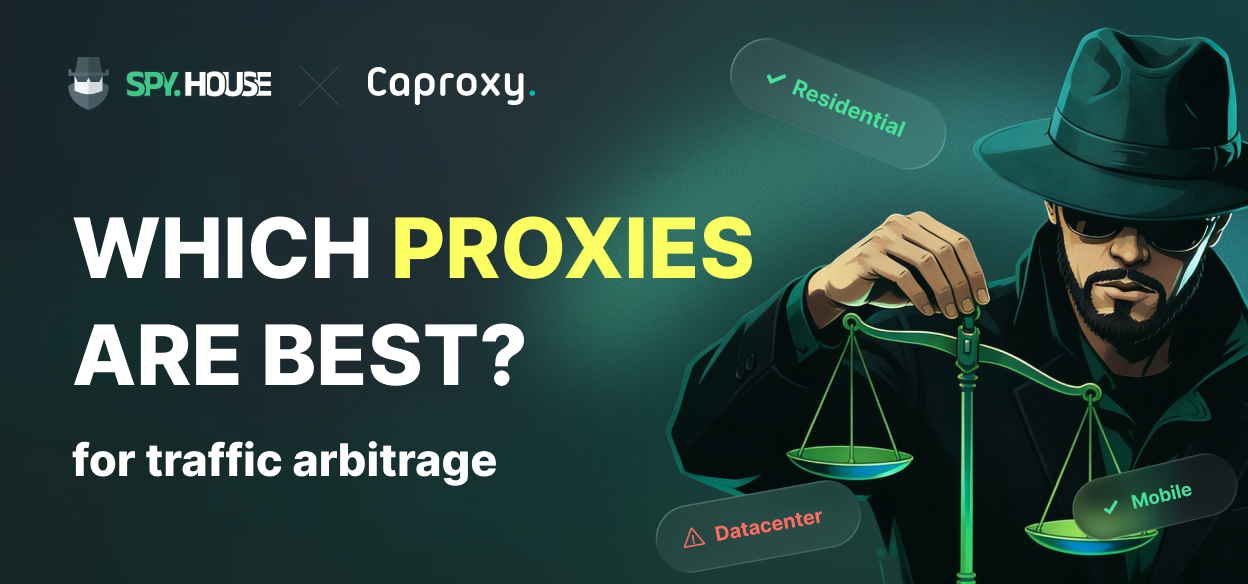
In this article, we will discuss which proxies are best to choose for traffic arbitrage, what you need to pay attention to, and provide recommendations for selecting and using proxies.
In arbitrage, you cannot do without proxies, and the wrong choice can lead to a ban on the advertising platform, causing your resources to be wasted.
Before we move on to the nuances of choosing a proxy, let's look at the criteria used by anti-fraud systems to determine that you are not who you claim to be:
Your IP address. The anti-fraud system analyzes which company owns the IP address, what type of IP it is, whether it has been previously spotted in spam databases, and whether it has overlapped with other users of the platform.
IP behavior within a single account. This analyzes how often the IP address and location change within one account. We will discuss this further, as it is very important.
Your device's digital fingerprint. It is important to understand that anti-fraud systems look not only at the IP address but also at your device's parameters. In this case, anti-detect browsers come to the rescue and are mandatory if you are engaged in traffic arbitrage.
Repetitive and anomalous behavior. If you were banned and then repeat your actions exactly when creating a new account, you may get banned again, even if you use a new proxy. For example, if you didn't warm up the account or "farm" cookies before launching an ad, you may also get banned.
Remember: It is important to always look like a real user and avoid repetitive patterns across multiple accounts so the system does not link them together.
However, it is also important to understand another thing: anti-fraud systems will not ban you for the slightest mistake. Nevertheless, you must approach the issue of bypassing anti-fraud systems responsibly to ensure your accounts live as long as possible.
Choosing Proxies for Traffic Arbitrage
Now let's move on to choosing a proxy for traffic arbitrage. Honestly, one could simply say, "buy mobile proxies," but it's a bit more complicated since the right choice should stem from the specific case and consider the following factors:
Vertical
Advertising platform
Number of accounts
Session duration within a single day
Duration of the advertising campaign
When you know what to look for, you can proceed to choose a specific type of proxy. We cannot predict your exact case, but we can explain the features of all proxy types, and after reading this article, you will understand which option is right for you.
Datacenter Proxies
These are proxies with IP addresses that belong to data processing centers. You may also encounter them under the names "IPv4" or "server proxies."
Are datacenter proxies suitable for arbitrage?
No. We do not recommend using these proxies in traffic arbitrage for advertising campaigns. They may be suitable for auxiliary purposes, but not for advertising. The fact is that using datacenter IP addresses is a red flag for anti-fraud systems. As soon as you launch an ad campaign, you will likely get banned. Such IP addresses do not look natural, and anti-fraud systems understand this perfectly.
ISP Proxies
These are proxies with IP addresses from Internet Service Providers; they are also called static residential proxies. They are not too expensive compared to the next types and have a static IP address, which is great for long sessions.
But there is a nuance that is rarely mentioned. The IP addresses do belong to ISPs, but the proxies themselves are hosted in data centers. In practice, this means that if an anti-fraud system wants to dig deeper, it can determine that the IP is resold and classify it as a datacenter IP. However, if these are good ISPs (with clean ASNs), getting banned is very unlikely.
Are ISP proxies suitable for arbitrage?
In general, ISP proxies can be used if you have "white-hat" niches, the platform has weak anti-fraud protection, and you need long-term sessions for several accounts. Don't forget that you can always test them: it's possible that for your tasks, ISP proxies will work, and you won't have to overpay for mobile ones. But if minimizing the risk of blocking is critical, this type may not be suitable.
Residential Proxies
These are proxies with IP addresses of real users. It works like this: people install special software on their devices through which they share part of their internet traffic with proxy providers, and the provider resells this traffic to you as a proxy.
Due to this scheme, these proxies do not have static IP addresses, and payment is based on traffic volume rather than per IP. Their advantage lies in a huge pool of IP addresses, flexible targeting, and fast location switching.
Are residential proxies suitable for arbitrage?
Yes, they can be suitable if you have short or inconsistent sessions and a traffic volume of up to approximately 10 GB per month per account. If it's more, it is more optimal to consider mobile proxies since they offer unlimited traffic. Also, when using residential proxies, it is important to remember two things; ignoring them can lead to a ban:
You need "sticky" sessions, where the IP address remains unchanged for as long as possible.
Set up detailed targeting, down to the choice of the Internet Service Provider.
It is important to understand that the anti-fraud system analyzes the behavior of the IP address. If it changes frequently, especially along with cities, it arouses suspicion, as regular home IP addresses change rarely.
Mobile Proxies
These are proxies with IP addresses of mobile operators. Their peculiarity is that many users can be on the same IP address at the same time, so anti-fraud systems are as loyal as possible to such IPs. Also, changing the IP within one user looks natural and does not cause suspicion.
The main disadvantage is their cost. The price depends on the country and averages about $60 per month per proxy. However, due to high trust and low risk of blocking, they are economically justified in most cases, which is why they are most often chosen by arbitrageurs.
Are mobile proxies suitable for arbitrage?
Yes, they are 100% suitable, especially when it is critical to avoid bans.
Recommendations for Choosing and Using Proxies
The choice of proxy type should be based on the specific task. If you cannot decide, choose mobile proxies.
Datacenter proxies are not suitable because the IP address must belong to real users.
The IP address within one account should belong to the same subnet, meaning it should not "jump" between cities and providers.
The IP address should remain unchanged for as long as possible, and ideally, it should be static.
Mandatory condition: 1 IP address = 1 account.
The country of the proxy must match the country you are running ads for. By the way, for a quick search, you can use the Caproxy website, which has filters by proxy type and country.
Conclusion
The choice of proxy directly affects the lifespan of accounts and the effectiveness of advertising campaigns. There is no universal solution, but in most cases, mobile proxies remain the safest option. At the same time, residential and ISP proxies can be a good alternative in less demanding scenarios.
To summarize the proxy selection, here is a table to help you make the right decision:
| Proxy Type | Trust Level | Risk of Ban | Payment for | Best Use |
|---|---|---|---|---|
| Datacenter | Low | High | Per IP | Not recommended |
| ISP | Medium | Medium | Per IP | White niches, long sessions |
| Residential | High | Medium | Traffic volume | Short sessions, scaling |
| Mobile | Very High | Low | Endpoint | Sensitive offers |





Comments 0